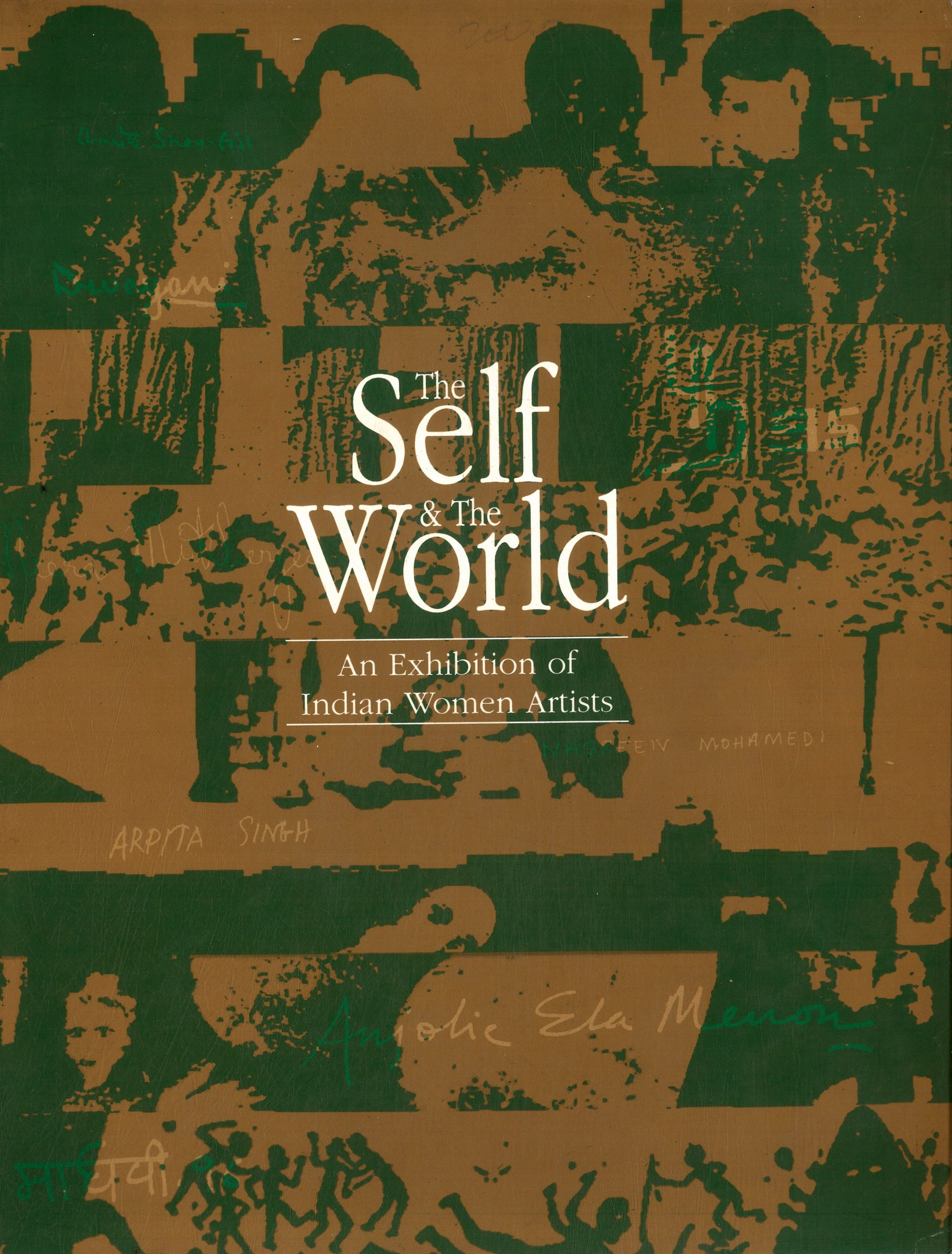
In her catalogue essay for a landmark exhibition of “Indian Women Artists” presented jointly by NGMA and Gallery Espace (April, 1997), art curator and historian Gayatri Sinha explores the notion of gender and feminine experience, through a potent philosophical formation – “The Self” and “The World”. This dynamic – a reassessment of the ways in which the individual self forms a relationship with the world – became the inspiration for the current edition. In a time of great upheaval and the unravelling of certainties, as the politics of gender and sexuality dominates the discursive space in the country, this positioning allows us to interrogate how art and creative practice could nuance ways of thinking about self-fashioning, self-making, self-identification, perception, association, and “being” in the world.
In their critique of the recent Transgender Persons (Protection of Rights) Amendment Bill, NCTP members Rituparna Neog and Kalki Subramaniam, who resigned from their posts in protest, called the amendment “a step backward for our fundamental rights to self-identification and dignity”. The bill that was hastily rushed through parliament has drawn criticism from all quarters, since it fundamentally alters the definition of “transgender”. By limiting the definition to biology and physical traits, and certain socio-historical communities, the state has upended the progress made in the politics of self-determination and self-perception, and dealt a blow to human dignity. Activists, lawyers, artists, and intellectuals have been vocal in their critique of this move by the state.
It has been close to four decades since American philosopher and gender theorist Judith Butler’s influential conception of “performativity” destabilised biologically determined sex by showing how gender as a category is socially constructed – “woman itself is a term in process, a becoming, a constructing that cannot rightfully be said to originate or to end. As an ongoing discursive practice, it is open to intervention and resignification.” (Gender Trouble: Feminism and the Subversion of Identity, 1990). Her arguments were foundational in formulating queer theory, and questioning notions of heteronormativity that ring through the recent amendment, where the state puts a wedge between the self, and the world, by legislating processes of medical certification, naming, and criminalisation. But Butler’s “performativity” is more than performance. Turning to J.L. Austin’s compelling 1955 lecture series, How to Do things with Words, we see how language is not restricted to speech – how, very often the very act of “utterance” brings a thing into being, by constituting it. Austin proposes the concept of “performative utterance” as “not, or not merely, saying something but doing something, as not a true or false report of something.” As a “performative utterance”, the amendment actively constructs the reality of transpersons thrusting entire communities of people into precarity under the guise of “protecting” them.
Can we think of the work of art – aggregated through practice, social and historical construction – as a “performative utterance”? If gendered identity is a form of self-expression, can the work of art speculate and constitute realities of being and relating that subvert regressive and limiting “definitions”? Is not the act of curation of close readings of such artworks a powerful shaping of reality – an act of world-making?
To curate and read these, and extend the reading to multiple contemporary works, that through their imaginative composition gender lived experience, and locate their performative utterances in an evolving socio-historical moment, is to formulate a fluid, speculative, and expressive bridge between the “self” and the “world”.
Sinha articulates the need to “establish/ acknowledge the woman artist as a ‘speaking subject’”. Through the current edition, we mark this contentious moment by revitalising the speaking subject’s speech – their art, and practice – as more than pronouncement, argument, or expression; we read the works of women artists, and queer artists as “performative utterances” that shape and change reality.
The attempt is not simply to speak, but to do gender.
***
Through a series of letters between friends, Aparna Chivukula and Stuti Bhavsar’s The Self and the World : Dialogues on Art and Friendship analyses some works from the exhibition in conversation with Nine Indian Women Poets, an anthology of poetry published in the same year, and edited by Eunice De Souza. The epistolary form opens up the reading of relationship and parallel practice, through a reflexive mould. A set of four “articles” in this edition push the boundaries of creative practice, and the formal collision of text and image. These are series of poems that write into and beyond, the work of art. Each of the poets chose artworks by a single artist, verbing the image into language, making it their own through poetry. Greeshma Gayatri’s Before They Came to Humans responds to artworks by Rashmimala, Kunjana Parashar’s Available Light responds to artworks by Manisha Gera Baswani, Nikita Deshpande’s City of Shard and Smoke responds to artworks by Soghra Khurasani, and Aranya Padil’s Babel of Broken Pencil Points responds to artworks by Shilpa Gupta. This set of works is experimental, proposing poetry as a means of creative engagement with art, outside of the contours of traditional “ekphrasis”, “critical analysis” or “art writing”. Nachiket Joshi’s commentary explores two exhibitions that form Nancy Adajania’s “curatorial diptych” of women artists from the 20th and 21st Centuries. In The Language of Lines: Breaking Out the Body, Carol Blaizy D’Souza sets off an in interrogation of beauty, and explores ways in which the body, and the ordinary, are rendered in a language of difference and juxtaposition through the works of Mayuri Chari and Priya Sebastian. In At the Crossroads : Contemporary Artistic Practices in Ladakh, Sudeshna Rana revisits the question of “contemporary” Ladakhi Art through an exploration of artists including Jigmet Angmo, Skarma Sonam Tashi, Anuja Dasgupta, and Tsetan Angmo among others. In Organic Monumentality: Latika Katt and the Ecologies of Form, Nainvi Vora explores how “abstraction becomes a mode of ecological thinking”, arguing that Latika Katt’s sculptures, writing, and practice expand the very ground of what is traditionally understood as “modernism”. Roma Chatterjee writes about “Memory, Loss, and the Ageing Body” by historically locating artist Anoli Parera’s artistic voice amidst aesthetic and social movements and fraught political histories of Sri Lanka. Zeenat Nagree reflects on Sayan Chanda’s “tapestries”. She shows how these works use myth and ritual to “distill the culture of worship around a little known goddess in the Sundarbans, into sculptural form”. In Poetics of the Ordinary Mansi Jain and Dev Nath Pathak argue that Nandini Chirimar’s practice foregrounds the poetics of everyday life. They show how her aesthetic approach wields ordinary objects as carriers of memory, identity and emotional resonance. Joshua Muyiwa reassesses Mandeep Reikhy’s A Male Ant Has Straight Antennae and the trajectory of his early works to foreground how “politics must power the physical expression”. His essay critically engages with the politics of queerness, and lived experience, in both contemporary dance practice, and criticism. Spriha Gupta performs a kind of ‘archaeology’ in A Kind of Blue by tracing the varied trajectories of stone, material, and method, in the use of Lapiz Lazuli across the ages. She traverses “networks of exchange” and “movements of knowledge” both geographic and temporal, in a compelling history of colour. Georgina Maddox takes a long view of the artwork of Sunil Gupta and Chitra Ganesh, two diaspora artists whose articulations of queer existence foreground a compelling range of aesthetic and socio-political concerns. She reflects on their practice, curating some of her own writings, and responses over the last two decades.
***
We invite you to join us in this adventure, through our curation. We wait for you at the shore, as you wade slowly through the waters of this edition, and enter into a dialogue that activates a bridge of expression between “The Self & the World”.