
The art practice of Nandini Bagla Chirimar in the series titled It’s the Little Things… and My Mother’s Closet, encompasses her engagement with everyday objects, domestic spaces and material processes. This essay is an attempt to explore how her artwork employs a process of distillation rather than narration, transforming personal objects into universal signifiers. Particular attention is given to her concept of ‘presence in absence’, enabling objects and interiors to evoke human experience without direct representation. The essay seeks to understand Nandini’s meticulous drawing practice, material choices and compositional strategies, and her detail-oriented art practice as a counterpoint to the dominant logic of contemporary art production in the wake of the global market. The essay argues that a methodological distinction of Nandini’s practice foregrounds the poetics of everyday life. An emancipatory art practice yields ordinary objects as carriers of memory, identity and emotional resonance.
Introduction: Reclaiming the Ordinary
The contemporary art world is fraught with spectacle, scale and immediacy. In such a context, Nandini’s practice turns inward and persistently towards the overlooked textures of everyday life. The series titled It’s the Little Things… resists grandeur, pomp and plush, and advocates, instead, for slowness, attention, and an almost radical commitment to the ordinary. She invites the beholder to pause, in front of familiar objects like rice grains, folded saris, cupboards and notebooks. Her drawings of domestic interiors and habitual gestures operate not merely as representations, but as critical sites where questions of memory, identity and cultural inscription unfold. This aesthetics of the ordinary characterises Nandini’s artworks.
At first glance, these works appear intimate, even autobiographical; however, they resist narrative specificity. Rather than recounting a singular life, they evoke a multiplicity of lived experiences. Through meticulous draftsmanship, careful material engagement and a contemplative process, the artist transforms the personal into the universal. Nandini’s practice navigates the space between object and emotion, presence and absence, and intimate and collective while contributing to ongoing discourses on material culture, domesticity and contemporary art practice. Through this approach, the everyday is not merely depicted but reactivated as a site of meaning.
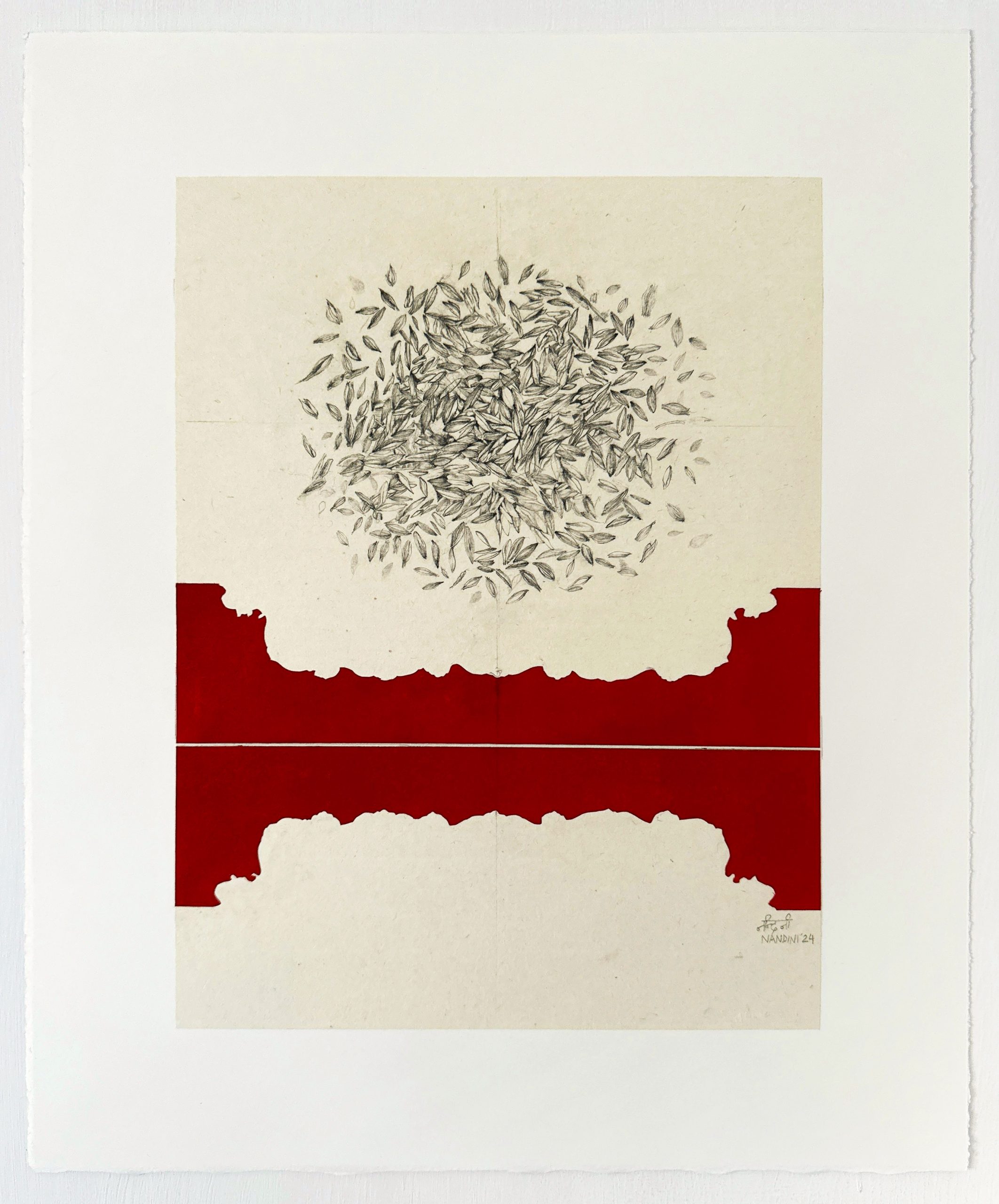
Fig.1 Nandini Chirimar, The Cycle of Life, 2024. Pencil, collage and hand ground Cinnabar and red lacquer pigments on Sekishu Natural Paper, mounted on Lanaquerelle. Image courtesy the artist.
The Affective Charge of Domestic Space
Nandini’s drawings frequently depict domestic interiors that are devoid of human figures. Yet, rather than appearing empty, they are charged with the presence of the affects of those who inhabit them. These spaces are not merely a physical structure, with physical anatomy crammed. The psychological and emotional currents that shape human consciousness are foremost in such spaces. Bedrooms, closets, kitchens and everything that may appear too ordinary to notice are refrains for deeper and further philosophical unraveling. The domestic sphere, as the primary site of human existence, enables intimate experiences and formative memories, shaping an inhabitant’s consciousness. This shaping is a mysterious, yet cumulative process that is reproduced every day through perpetual interface between the space and inhabitants. This slowness is reflected in the nature of the drawings, and the ways in which abstract colours such as red, black and gold, provide a counterpoint to the creations.
This renders domestic spaces into living archives rather than inert containers, imbued with emotional and temporal depth. Despite the outward facing nature of contemporary life, public roles, professional identities and digital presence, it is within domestic environments that daily rituals unfold. These spaces hold the rhythms of daily existence from waking, resting, and cooking to organising, and therefore become integral to understanding how individuals relate to their surroundings. The interaction of interior and exterior, and the complex implications of such an interaction, render isolated objects and reconfigured spaces as evidence of prior inhabitation in Nandini’s aesthetic and intellectual scheme. A worn out carpet, a neatly arranged closet or a folded sari becomes a marker of lived experience. She removes them from their immediate context, retaining their affective charge, and they surface as a series of reassembled fragments that produce new meanings. Many artworks emerge from observing and reconstructing spaces. The interiors of such spaces are not merely technical representations, but recomposed environments, shaped by memory and perception.
Objects of Lived Experience
At the core of the series of artworks It’s the Little Things… lies a deceptively simple premise, i.e., objects define us. In domestic settings, everyday life objects function as its primary agents. However, Nandini articulates a crucial proposition ‘objects form accurate portraits of people… more than their faces’. Objects thus become tangible testimonials, revealing behaviour and feeling, while becoming active participants in shaping identity and personhood. This resonates with Roland Barthes’ treatment of the mythologies of the contemporary world where everyday objects function as signs within cultural systems, carrying meanings that extend beyond their functional roles (Barthes). Objects that belong to ordinary everyday life like rice grains, envelopes, garments or utensils are deeply embedded within cultural contexts. For instance, the recurring motif of roli and chawal (vermilion and rice grains) invokes a complex semiotic field of ritual purity, auspiciousness and cultural continuity.
Everyday items like books, utensils, fabrics, etc., closets filled with saris, boxes of embroidery threads or neatly arranged domestic spaces begin to function as psychological maps. Ordinary objects constitute a cartography of emotions that holds the possibility of enriching our understanding of humanness. Each fold, texture and arrangement becomes a clue suggesting habits, memories, aspirations and histories. The portrait emerges not through depiction of the individual, but through the silence of objects. This is the speech-act of silence underpinning an ordinary object that is a repository of hidden meanings. Nandini provides departure from the traditional notions of portraiture, shifting focus from the visible body to the material traces of lived experience.
A defining feature of Nandini’s practice is her deliberate avoidance of direct narrative. Claiming to resort to lived experience, there is a conscious attempt to not present a specific story or personal account. Instead, it operates through distillation, transforming specific objects into generalised forms retaining their associative potential. This approach helps her work to deliberately avoid becoming confessional or autobiographical. An object in her drawing is not ‘her’ object; it is an object that could belong to anyone, anywhere. There is an aesthetic transformation of particular into universal. By removing the anchor, a singular story, she opens the work to multiple engagements and interpretations. A viewer encountering a drawn cupboard or sari does not read it as a document of the artist’s life, but as a mirror reflecting their own experiences. The work becomes a site of projection.
Nandini’s refusal of autobiographical narrative is particularly significant in the context of several instances of contemporary art that foreground personal experience as an absolute. This strategy aligns with her intention to create symbolic rather than narrative imagery making it available as a universal system of signs. The objects function as catalysts for memory and reflection, prompting viewers to ask: What does this remind me of? What similar object exists in my life? How has it shaped me?
Presence in Absence, Ethics of Slowness
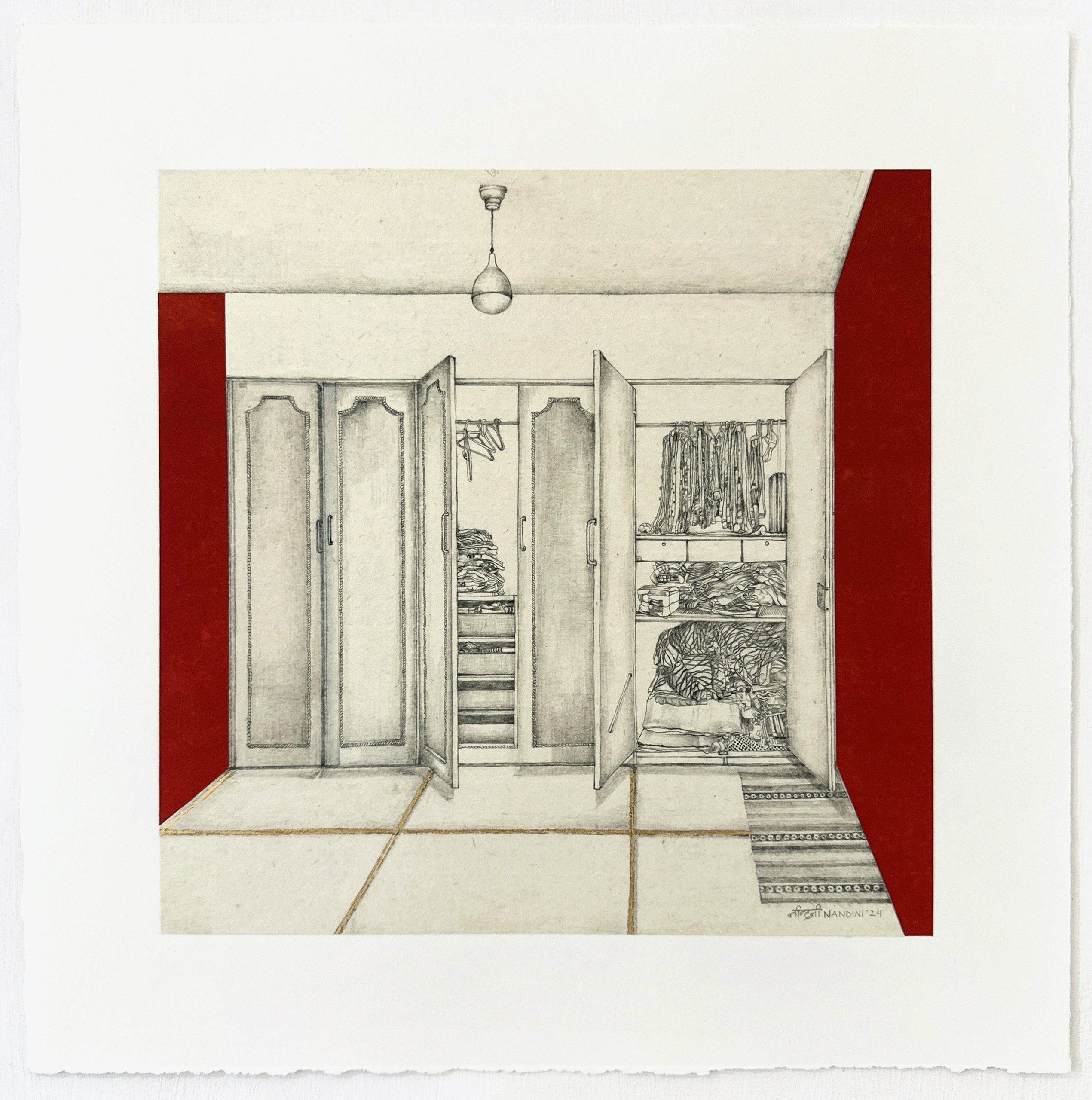
Fig.2 Nandini Bagla Chirimar, Just The Way She Left It (3). Pencil, collage, 23.6 carat gold leaf and hand ground Cinnabar and red lacquer pigments on Sekishu Natural Paper, mounted on Lanaquerelle. Image courtesy the artist.
Across the arc of her work, one of the most consistent and most searching preoccupations is what might be called the phenomena of absence. Her drawings often depict objects and spaces devoid of human figures, yet these absences are charged with presence. Objects and spaces carry traces of material residues of past actions, emotions and relationships. This becomes particularly significant in relation to memory. By isolating and rendering these objects, Nandini highlights their capacity to evoke what is no longer physically present. A teacup suggests conversation; a mirror implies reflection; a worn carpet indicates repeated passage. The emptiness is thus not empty at all. It is dense with the invisible presence of the people who had filled it, once upon a time. In so doing, it discloses a tyranny of time. These elements suggest an underlying emotion, history or association. They operate as visual intensifications, drawing attention to what cannot be directly represented, shown and seen. However, under-represented is not necessarily un-represented, just like a subtext is not inferior to the text. The unseen thus is as acutely palpable as is the seen.
Along with the intrigue of absence, and spectral presence of the absent, Nandini’s use of Japanese woodblock printing and meticulous pencil drawing is inseparable from her conceptual concerns. Medium, in her work, is not merely technical, it is argumentative. The slowness of the process is itself a perspective and position. Her practice is characterised by the use of hand extracted pigments such as cinnabar and malachite, reminiscent of Indian miniature painting. However, rather than invoking nostalgia, she engages these materials as living traditions, recontextualising them within contemporary discourse. This kind of engagement with material introduces an “ethics of slowness”. She describes how the process of mixing natural pigments itself becomes a moment of pause. Unlike ready-made materials, these pigments demand preparation, time and care introducing a rhythm that resists haste. There is also a cultural dimension to this choice – Nandini speaks fondly of growing up in Jaipur, a city of artistic heritage which includes a tradition of miniature painting, natural pigment preparation and meticulous hand craft. In this way, traditions of art-making and craft from the region find an inarticulate presence in Nandini’s art practice. She maintains her commitment to slow, labour-intensive processes that can be understood as a form of resistance. This slowness allows for deeper engagement with the artwork, and a defiant rejection of the dominant logic of art production in the lucrative age of art merchandise.
My Mother’s Closet Series: Memory and Cultural Continuity
In contrast to the series of artworks It’s the Little Things…, the My Mother’s Closet series offers a more focused exploration of a specific object category, the sari. A central motif that belongs to feminine everyday life, functions in this series as a cultural text, encoding histories of gender, identity and tradition. Dwelling upon her mother’s collection, these works delve into the emotional and symbolic weight carried by garments. Her drawings of saris can be read as textile archives, where intricate details of each fold, pattern and texture form composite images.
Nandini’s engagement with her mother’s saris introduces an intergenerational dimension, at the intersection of continuity and change, perpetuity, and transformation. Across generational transmission, with evolution of cultural practices, the meanings associated with objects like the sari may shift. The sari becomes a site of reproduction and rupture, cultural persistence and fluidity.
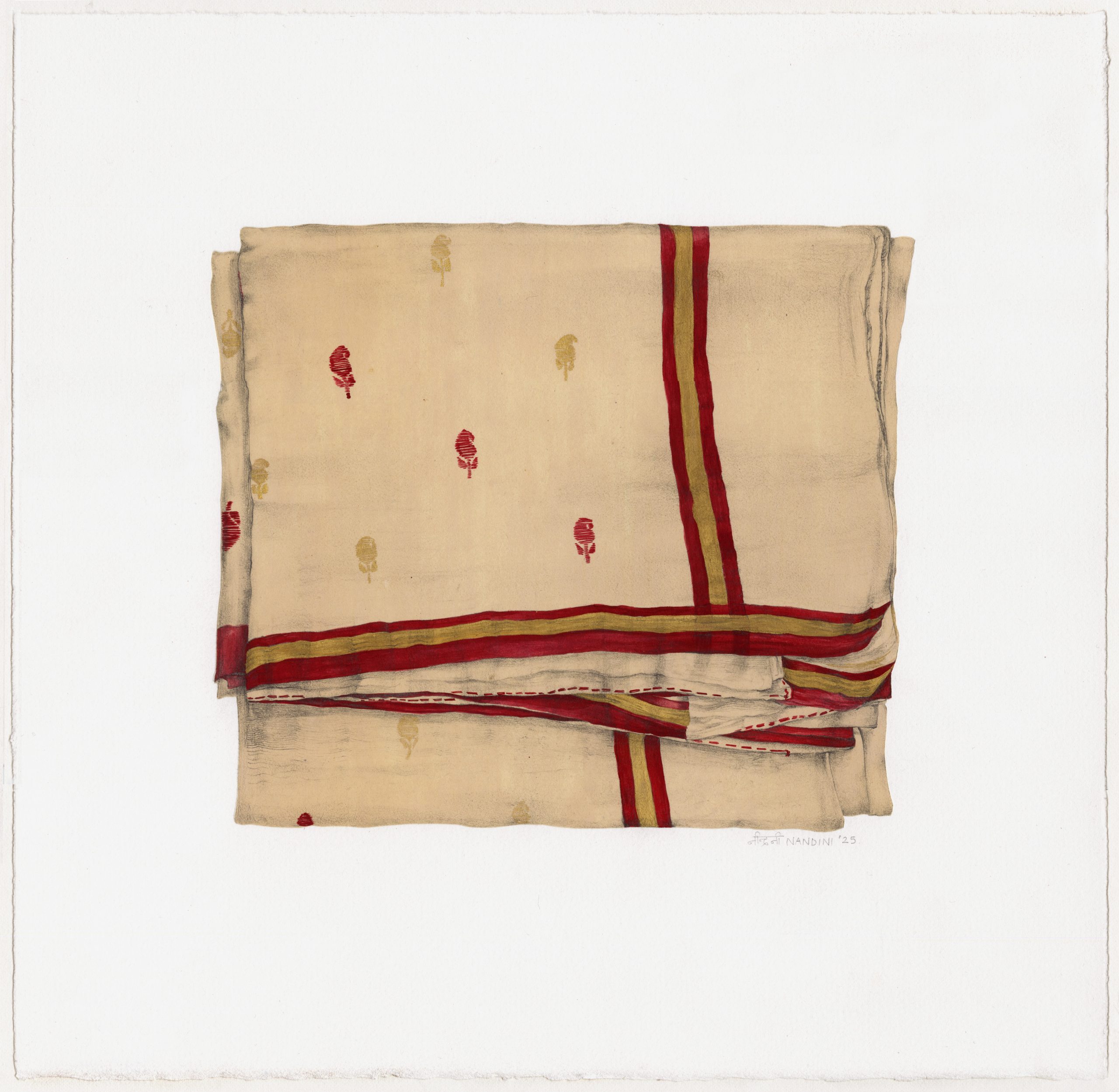
Fig.3 Nandini Chirimar, Her Pooja Sari. Pencil, hand ground stone pigment, watercolor and 23K gold ink on Kaji natural and Rives paper. Image courtesy the artist.
To reiterate, Nandini does not work within the confines of structures of representation. Embedded in observation, her compositions entail a process of reconstruction, assembling elements from multiple sources to create new spatial arrangements. Her practice encompasses a wide range of specific activities: photography of objects and spaces, and multiple variations of images subject to digital reconstructions, coupled with very fine linework and drawing. Nandini’s method reveals the logic of montage, where meaning emerges through juxtaposition and recombination. By manipulating spatial relationships, opening doors, rearranging objects, and altering compositions, Nandini curates spaces that are simultaneously familiar and uncanny. They occupy an intermediate zone, familiar yet estranged, inviting viewers to navigate between recognition and abstraction. The aesthetic goal in her scheme is not realism; instead, it is compositional coherence. By reconstructing spaces, she underlines the fluid meaning of an image, not fixed but amenable to reconstruction and reshaping through composition. The arrangement of objects becomes as significant as the objects themselves.
One of the most compelling aspects of Nandini’s work is its capacity to generate viewers’ identification with her works. She notes how ‘audiences often respond by mapping their own experiences onto the depicted objects’. A cupboard becomes a cupboard one has known; a sari becomes one’s mother’s or grandmother’s; a room becomes a space remembered. Nandini’s objects evoke a personal engagement from all who set eyes on the work. The familiarity of the objects invites viewers to inhabit the work, to see their own lives reflected within it. The mechanism through which she achieves this is a kind of radical generalisation that operates through openness, allowing objects to function as open points of engagement rather than fixed conclusions. An embroidery box found at the back of a closet is not a particular woman’s embroidery box. It is through an epistemic dislocation, a generic category of the embroidery box that can be owned by one and all. A generality is owed to the universal condition of the half-finished project, the forgotten aspiration, the thing that was put away because life moved faster than intention. When viewers encounter the work, they do not think of Nandini’s domestic archive. They think of their own.
To return to Barthes, a text is free from the determination of the author once it’s out in the public. Such a text is perpetually reproduced through acts of reading by multiple readers. The objects cease to belong to the artist; they become shared cultural artifacts.
Conclusion: A Poetics of the Everyday
Nandini’s practice offers a nuanced exploration of the relationship between belonging, identity, memory and cultural context. Through a practice grounded in precision, slowness and conceptual clarity, she redefines the significance of the ordinary. Ultimately, her practice foregrounds the importance of attention, memory and material engagement in shaping human experience. By focusing on the ordinary, she reveals its complexity.
The absence of human figures shifts attention to the material environment, where traces of life are embedded. Through this approach, presence is conveyed indirectly, emerging through objects and spaces. The emphasis on process, material choices and slowness further distinguishes her practice, positioning it as a thoughtful response to the pace of contemporary art production. By focusing on the everyday, she foregrounds the importance of attention in both making and observing. In a time characterised by speed and excess, her work quietly insists that the little things are not little at all, the smallest details carry the deepest significance.