
Dear Stuti,
I can’t say exactly when it was that we became friends, but I think it has something to do with the months we lived in the same room, not speaking a word to each other, and then that one evening we decided to break the silence. It remains something of a reassuring mystery, how our silence finally accumulated into conversation — and the kind of more relaxed, knowing silences we share now, on call, or at a friend’s house, or walking around an exhibition. Perhaps the first silence was a hurt which grew out of not knowing how to read one another.
There have been many shows in the last few years which in their titles or adjoining notes announce ‘care’ and ‘friendship’ as a curatorial strategy, but holding that word as a compass I have felt lost among the exhibits. The ‘economies’ of friendship in the industry are apparent enough and have received a fair amount of attention — but I wonder about the care that lies outside this economics, which is more felt, less obviously quantified or pronounced. I mean the feeling of poring over a Word document late into the night, and a familiar face in the screen points out, it’s this line that’s causing the problem, it’s too stiff — or when a friend worries that there’s something off about his new paintings, and I can imagine out loud with him what could be the matter, having been attentive to his practice for years, knowing what kind of painting he wishes for. Is there a way in which this kind of companionship sutures itself into our work, as a strand of hair sometimes gets woven into one’s knitting — as a felt presence? Maybe discerning this kind of care between artworks could be a question of re-learning how to read one another, and the ways in which we carry out this ask and act of reading.
I don’t mean for friendship to sound so evenly pleasant or romantic — but it can be confrontation turned productive. In an interview, artist Anupam Sud mentions the influence of the “sawal-jawab format” on her practice, “where musicians perform in a back-and-forth dialogue, improvising on well-known signatures”, and in her series of etchings titled ‘Dialogues’, she details layers of worry, confusion, absence, and pause, between companions. ‘Dialogue VIII’ presents two figures sitting with a problem.
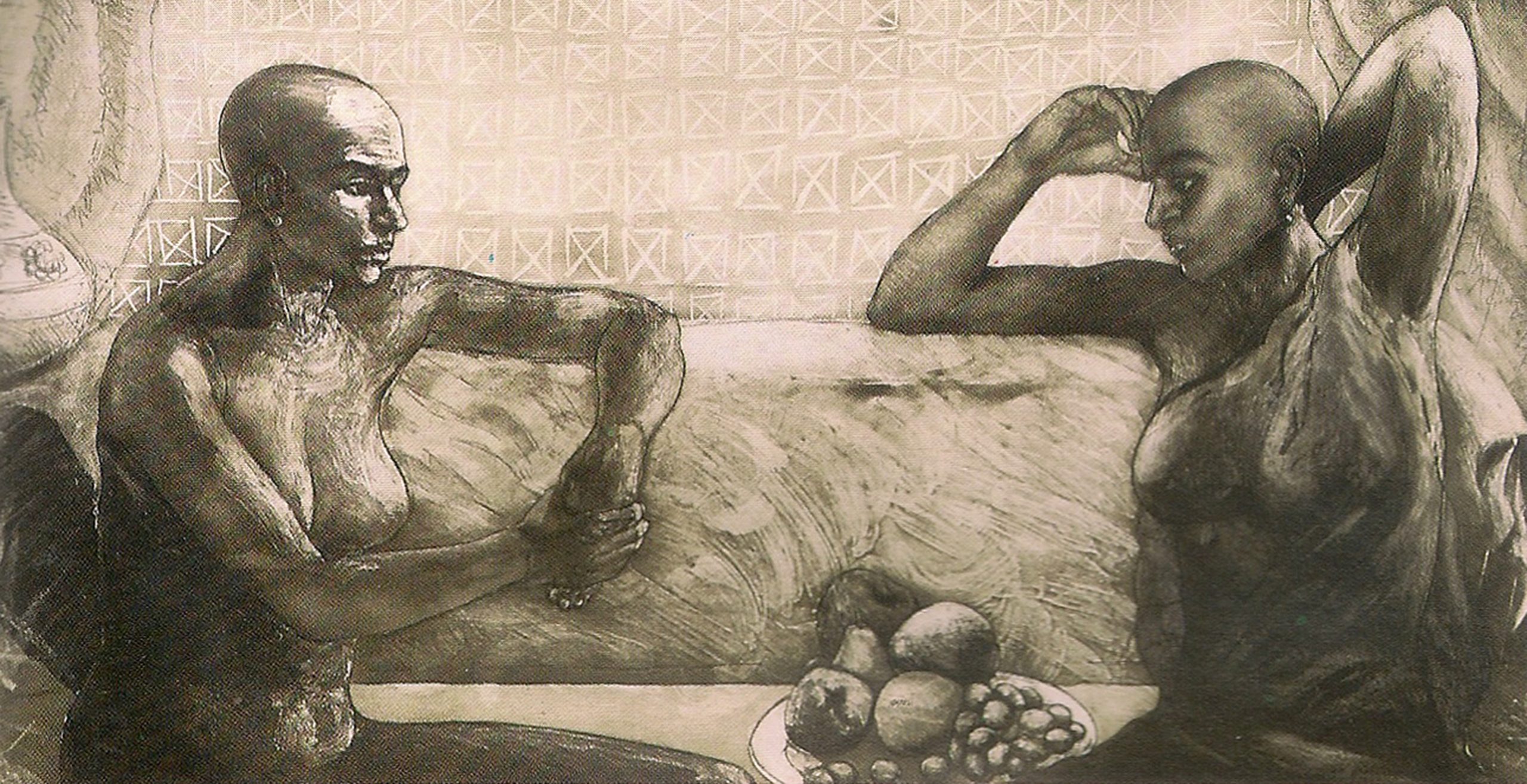
Anupam Sud, Dialogue VIII (1992), Etching on zinc plate, 49.5 x 97 cm. Featured in The Self and the World Catalogue, Courtesy Gallery Espace.
It is difficult to say what exactly the worry is — but they share it between them, lost in thought, not looking at each other, but at that third, absent thing. One clasps their own hand, and the other holds their head, and their bodies stay turned towards each other. A plate of fruit has been brought out, but sits untouched. The ‘dialogue’ rests in this moment of unresolved thought, where we are unable to read who it was that spoke last, or about what — only that the weight of it falls on both brooding figures.
Sud’s ‘Dialogue VIII’ was shown as part of ‘The Self and the World’ (1997) curated by Gayatri Sinha and held at the National Gallery of Modern Art in collaboration with Gallery Espace Delhi. In the same year, the anthology ‘Nine Indian Women Poets’ was published, edited by Eunice de Souza. In poems such as Mamta Kalia’s ‘After Eight Years of Marriage’ which goes: “The first time I visited my parents, / They asked, ‘Are you happy, tell us.’” — the ‘you’ registers as addressed both literally to the poet-speaker, yet also slants as an invitation towards the reader – similar to the oblique, personal address which marks Sud’s ‘Dialogues’ series. The viewer/reader in these works is not asked to be a mere outside witness – they are strung into the works’ formal compositions, privy to what is being shared between friends. Kalia responds to the question in the first person: “…I should have laughed at it. / Instead, I cried, and in between sobs, nodded yes” – and a reader like me holds their own hand or clutches their head, and reads on.
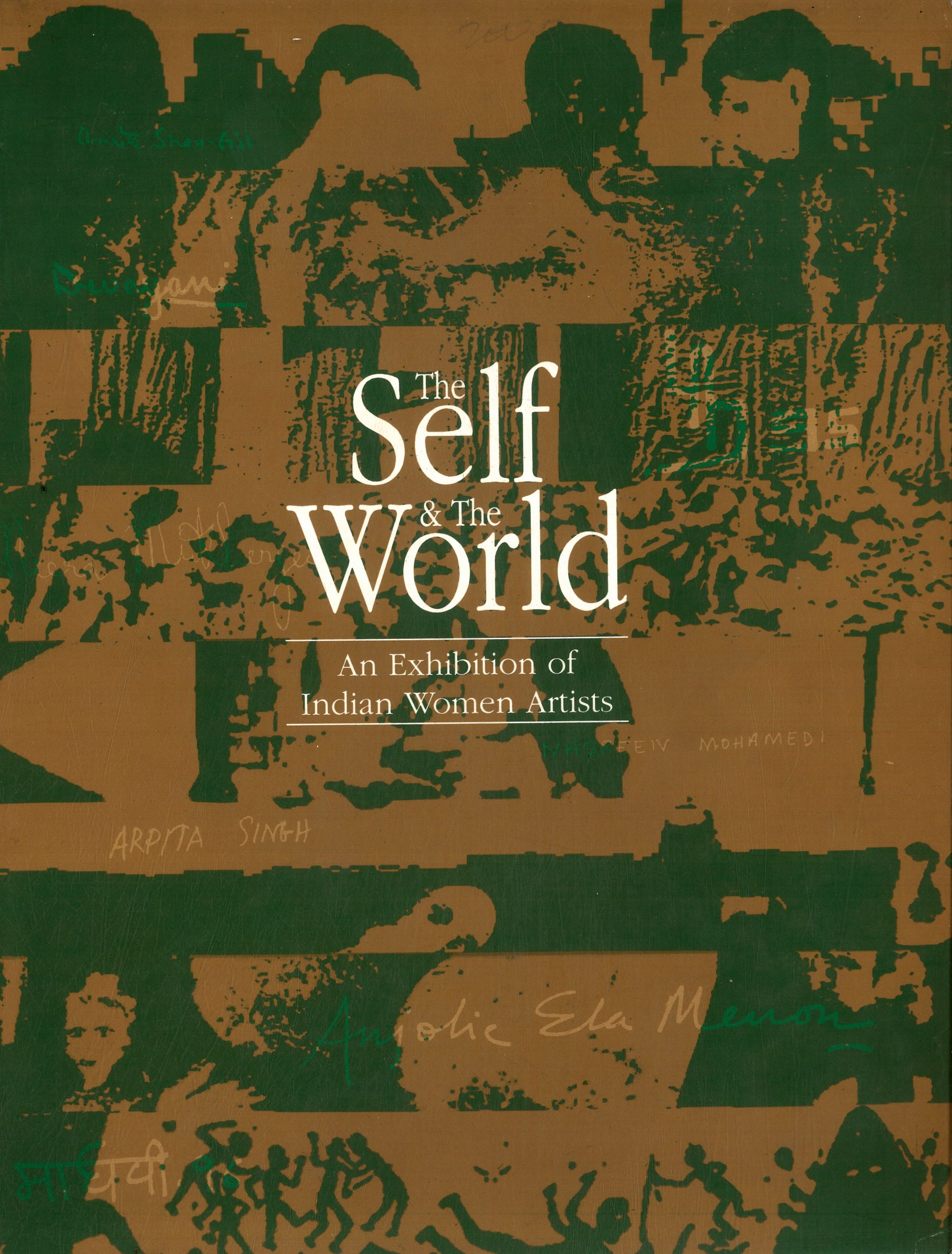
Cover of the catalogue of the exhibition The Self and the World (1997), edited by Gayatri Sinha, published by Gallery Espace and National Gallery of Modern Art, New Delhi. Courtesy, Gallery Espace.
In Sinha’s essay introducing ‘The Self and the World’, she writes about gender as a “cause for unromanticised self appraisal”, taken on by the artists’ “questioning, even subversive vision(s)”. The poems in De Souza’s anthology echo this sentiment, in their manner of looking and voicing, preoccupied by “time, history, social problems, religious search, the environment, painters, writers, language”. It seems important that these two events did not take place in isolation, that they carry resonative inquiries and desires, conversing across geographies and forms, offering, even if unwittingly, renewed ways of reading one with another.
So I look at Sud’s ‘Dialogue VIII’ and hear Kalia: “…how I wept in bed all night once / And struggled hard from hurting myself.” I’m imagining this relation, but that might be the point; the ask is that we imagine.
I hope you had a lovely morning birdwatching.
Aparna
Hi Aparna,
For some time, I have been thinking about frameworks and analogies related to structures of togetherness and processes of care, and an experience from the 2024 winter has resurfaced as a milepost, guiding that thought. I thought I’d share that in relation to works that stayed with me from the anthology and the exhibition, drawing from the companionship of ‘imagination’ and thinking further about reading.
Initiated and sustained by the Rastogi family, Savitri Urban Food Forest is a small farm developed on barren land, designed using repurposed industrial scrap and construction debris, and nestled in Vadodara’s residential sprawl. It often hosts educational activities, jam sessions, and eco walks, bringing together people across age groups, disciplines, and interests who share a curiosity about its regenerative approach. During one such walk in 2024, I learnt not only about the migratory journeys taken by Rosy Starlings and their place-making abilities, but also about the companion planting system. Here, species with different needs and roles are placed in proximity based on their compatibility, together creating a self-sustaining environment for growth—a structure of mutuality within the economy of space. The stable verticality of maize would provide trellis-like support to beans and shaded space to pumpkins. Contributing to nitrogen fixation, the beans enabled nutrient production and reduced dependence on fertilisers. The pumpkin, with its tendrils and leaves blanketing the ground, aided water retention and deterred weeds.
The reciprocity and symbiosis at play within the companion planting system offered a framework to reflect on togetherness and space-making in crowded urban cities, where one longs for the arc of friendship—a gentle nook amidst the tedium and unending demands of daily life or the alienating environs when one shifts base and seeks a sense of belonging. It became an exercise in composition to reflect on proximity and relations, nurtured by shared experiences, adaptations, varied potentials, and even remote structures of support, while holding space for differences.
It helps to think of proximity as congeniality. In her preface to the 1997 anthology Nine Indian Women Poets, which you refer to, Eunice de Souza makes a case for affability that may not follow immediate temporal co-existence. But where one finds an ally based on style, form, and voice with distant figures, their works, and beings.

Nine Indian Women Poets: An Anthology (1997), Book Cover (Hardcover), edited by Eunice de Souza, published by Oxford University Press.
From the anthology, I was struck by the poet, artist, and filmmaker Imtiaz Dharker’s visual poem Living Space (1997) about chaotic temporary dwellings and fragile everyday conditions in slums, where a tender ‘living’ space has been tenuously held with minimal resources by dwellers, even as “nails clutch at open seams and the whole structure leans dangerously towards the miraculous.” Here, space-making as familial and community effort is understood as an everyday, incessant work to hold things together, even as they labour for newer, stabler construction unfolding around them at a rapid rate. The image that impresses upon memory is her observation of a basket of eggs within the unstable structures, whose gentle, gleaming curves are a shield against the “dark edge of a slanted universe”.
I couldn’t help but read the poem alongside Pilloo Pochkhanawala’s works from the 1997 exhibition, The Self and the World: An Exhibition of Indian Women Artists. Her sculptures seemed like the figurative and material companion to the spatiality conjured by Dharker—not as illustrations, but as accompaniments to read urbanity and our relations with it.
For instance, Teeming Millions (circa. 1950) encapsulates the crowded situation in metropolises, where development and decent livability continue to be at loggerheads, where many communities migrate with a hope for a better life. The lead-based sculpture of a nondescript and dynamic group of figures appears rising like a human pyramid. Each figure, a node in the dense agglomeration, is connected to and supported by another in mutual trust, even when in a position of precarious balance, striving for sustenance.
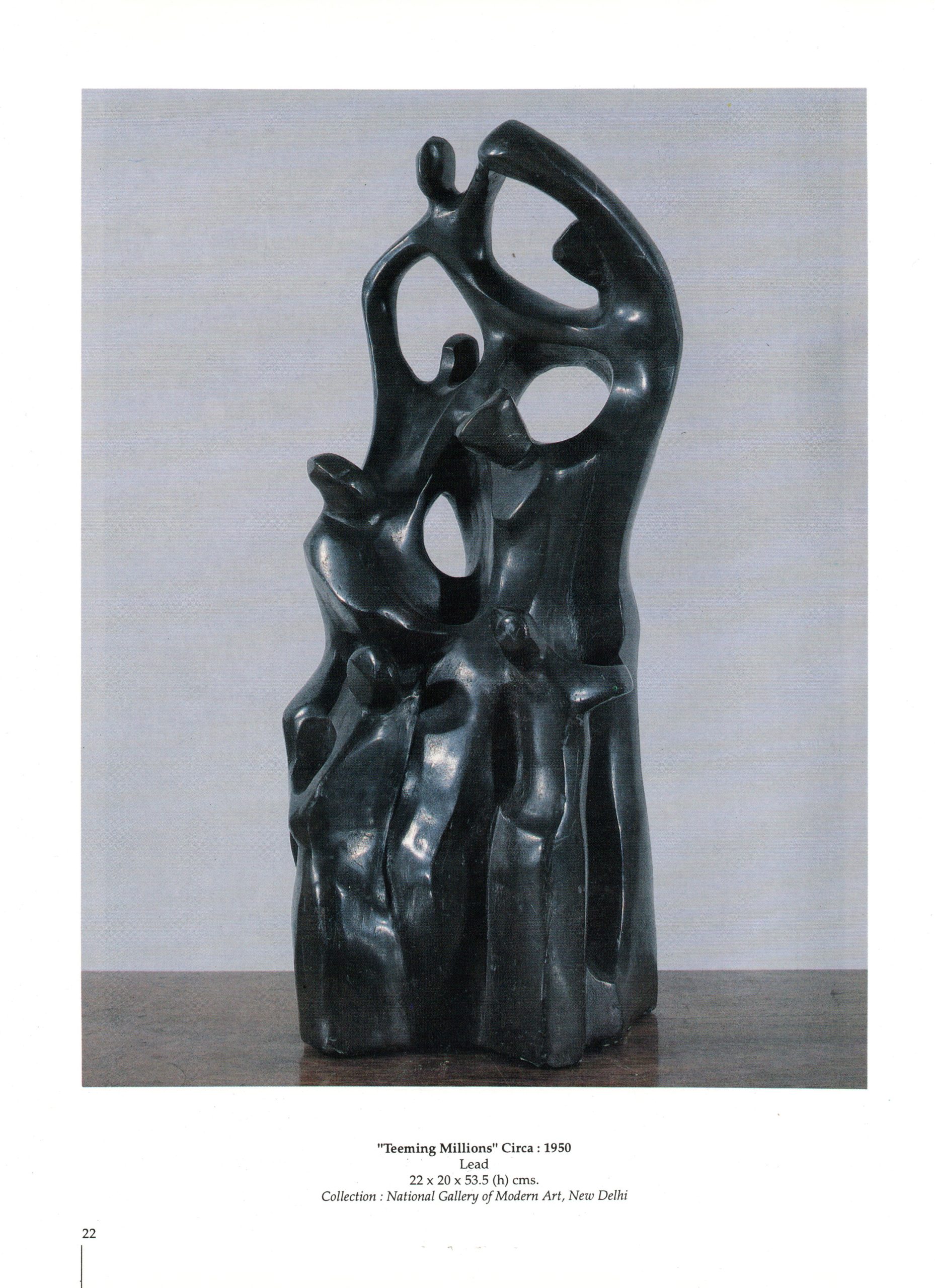
Pilloo Pochkhanawala, Teeming Millions (Circa 1950), Lead, 22 x 20 x 53.5 cm. Collection: National Gallery of Modern Art, New Delhi. As Featured in The Self and the World Catalogue, Courtesy Gallery Espace.
Indexing the erosional processes of creation, destruction, and reconstruction, the public sculpture Metal-scape II (1975) is an assemblage resonant of weathered industrial and natural ruins and was made by welding scrap aluminium panels—a lightweight, low-cost building material. In the note within the exhibition catalogue, Pochkhanawala shares how she would work with the form in which the material was found, where each mark—like citational traces of its handling, shaping, and conflicted uses by hers and others—would be retained. The textures of the rugged beam, stump, and plinth-like forms speak to the lived experiences within the makeshift dwellings in Dharker’s poem and the vestiges of life and home that are left behind. The ‘living space’ then also harbours marginal experiences of the metropolis, seeing how lower-income communities are pushed to be proximal to waste and incessant precarity. Like certain proximities, the dooming shadow cast upon some, to the point of illegibility, aren’t innocent workings after all.
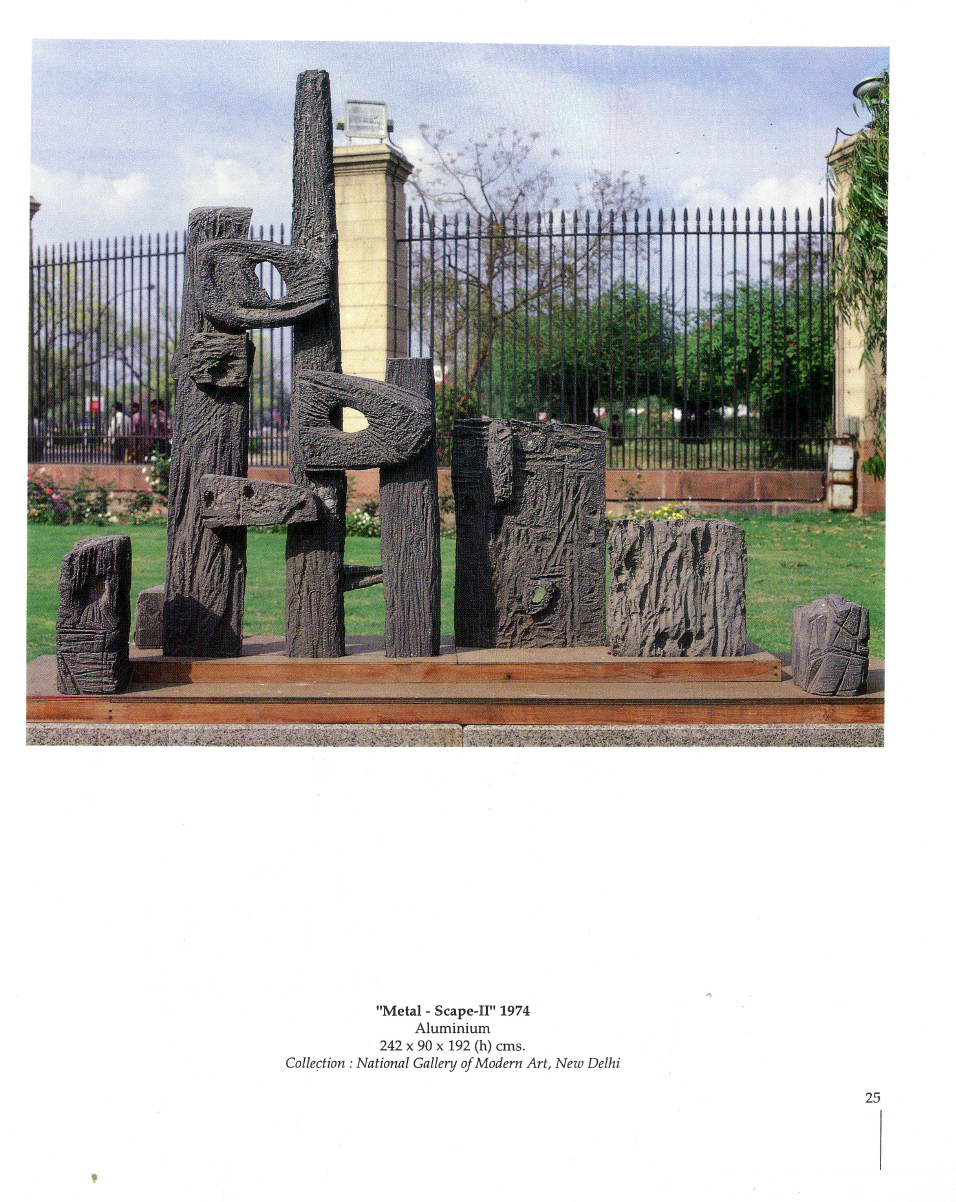
Pilloo Pochkhanawala, “Metal-Scape II”, 1974, Aluminium, 242 x 92 x 192 (h) cms, Collection: National Gallery of Modern Art, New Delhi. As Featured in The Self and the World Catalogue, Courtesy Gallery Espace.
Sinha’s selection indexed Pochkhanawala’s journey with industrial metals as she worked out of a friend’s factory. She was also a community organiser, built public installations, and was one of the first modernist women sculptors in the early decades of the post-Independence period, encountering rapid industrialisation and infrastructural development, who explored the language of abstraction while delving into metal alloys, welding, metal beating, and fabrication. Pochkhanawala’s departure from sculptural processes of carving—of subtraction, of arriving at the pure form/mental image, of ‘is’—towards welding and assembling, of ‘can be’, new wholes, and making do with existent matter in circulation, where the parts still have their former selves in the conglomerate, is equally striking.
Her figurative, spatial, and biomorphic forms have been sensitively rendered using the flaming soldering iron, the crude blow of the hammer, and the technicalities of furnaces during casting, subverting the process’s associations with masculinity and also sitting insincerely within the ascribed feminine qualities of delicateness, emotivity, and timidity. I have often felt that working with metal, among many other materials, entails meeting the material’s affordances halfway, where various kinds of resistances [of oneself and the matter’s], temperaments, and feminine and masculine attributions converge, as in the process of building and sustaining a home, while weathering tides. In the act of making and material conversation, involved matter and bodies change with passing interactions, as within a friendship.
While Pochkhanawala (1 April 1923 – 7 June 1986) belonged to a mercantile Parsi family and was based in Mumbai, Dharker (b. 31 January 1954), a Pakistan-born British poet, filmmaker, and artist, has called Mumbai her home from time to time. Their expressions of culture, urban experience, resistance, gendered roles, and, more importantly, rootedness and displacement, as they negotiate their hyphenated identities, belonging, and otherness, while the fervour of monoculture continues to wreak havoc, offer much for thought on proximity and space-making. It is uncertain if their paths ever crossed in the city that teems with a million dreams and a million accompanying frictions. Yet in 1997 and later, they met, perhaps unknowingly, in repositories. Their exploration of motifs of support, the city, and reclaimed recesses of aliveness helps comprehend how companionship turns a space into a place, from time to time, offering direction, expanding outlooks, and making the present more navigable.
Perhaps the way Pochkhanawala and Dharker weave the abstract and figurative, while thinking with the metaphor and material of joinery and the process of building, whether bonds or a home, might intrigue you as a fellow traveller. Perhaps how the works echo the inner worlds and conditions of production and being, even as they hold multitudes, imbalances, and polarities in their folds, might serve as common ground for shared explorations.
— Stuti
Dear Stuti,
The balance you described among the maize, beans, and pumpkin plants, as three companions — reminds me of a list translated from the Kuruntokai by AK Ramanujan in ‘The Interior Landscape’, of some well-defined occasions when a heroine’s friend speaks out, in Sangam poetry:
“…when the heroine, left behind by her lover, speaks of her loneliness; when she [the girl-friend] helps them elope; when she begs the hero to take good care of the heroine; when she tries to dissuade the parents from their search for the runaway couple, or to console the grieving mother…”
Traditions as old as gardening have arranged for themselves structures of when and how companions step in, the role each plays, and how one might nurture another. These frameworks have been borrowed, questioned, and reworked — as in Kalia and Sud’s work, in the Sangam tradition “the reader only overhears what the characters say to each other, to themselves, or to the moon” — and this doubleness of the direct address of “you” or “I” grows further complexed by the modern artists’ abstractions and uncertainties around selfhood, in relation to family, state, gender, and sexuality. In her introduction to NIWP, De Souza remarks that the modern poets share striking resonances, in terms of tone and idiom, to Prakrit poets and the early Buddhist therīs, learning from or responding to those earlier traditions of composition — and inventing new colophons, situations, and signatures for themselves.
The currents that produce an artist’s own practice, work, and ideas run alongside an attention to those of others, meeting, crossing, and departing freely. For example, in Anju Dodiya’s charcoal and watercolour paintings on combined pieces of fabric, such as ‘Ignition’ and ‘Shadow Lines’, from her 2018 exhibition ‘The Air is a Mill of Hooks’ at Vadehra Art Gallery, I find echoes of Nilima Sheikh’s “Post Partum-VI” (1995) shown as part of ‘The Self & The World’ in 1997. Across these compositions, rest or silence or daydreams are sought underground, beneath a horizon line — a woman in a room just big enough to hold her and her companion, whether a book or a baby, with slices of the world separate but visible to her; she decides how much she wants to see.
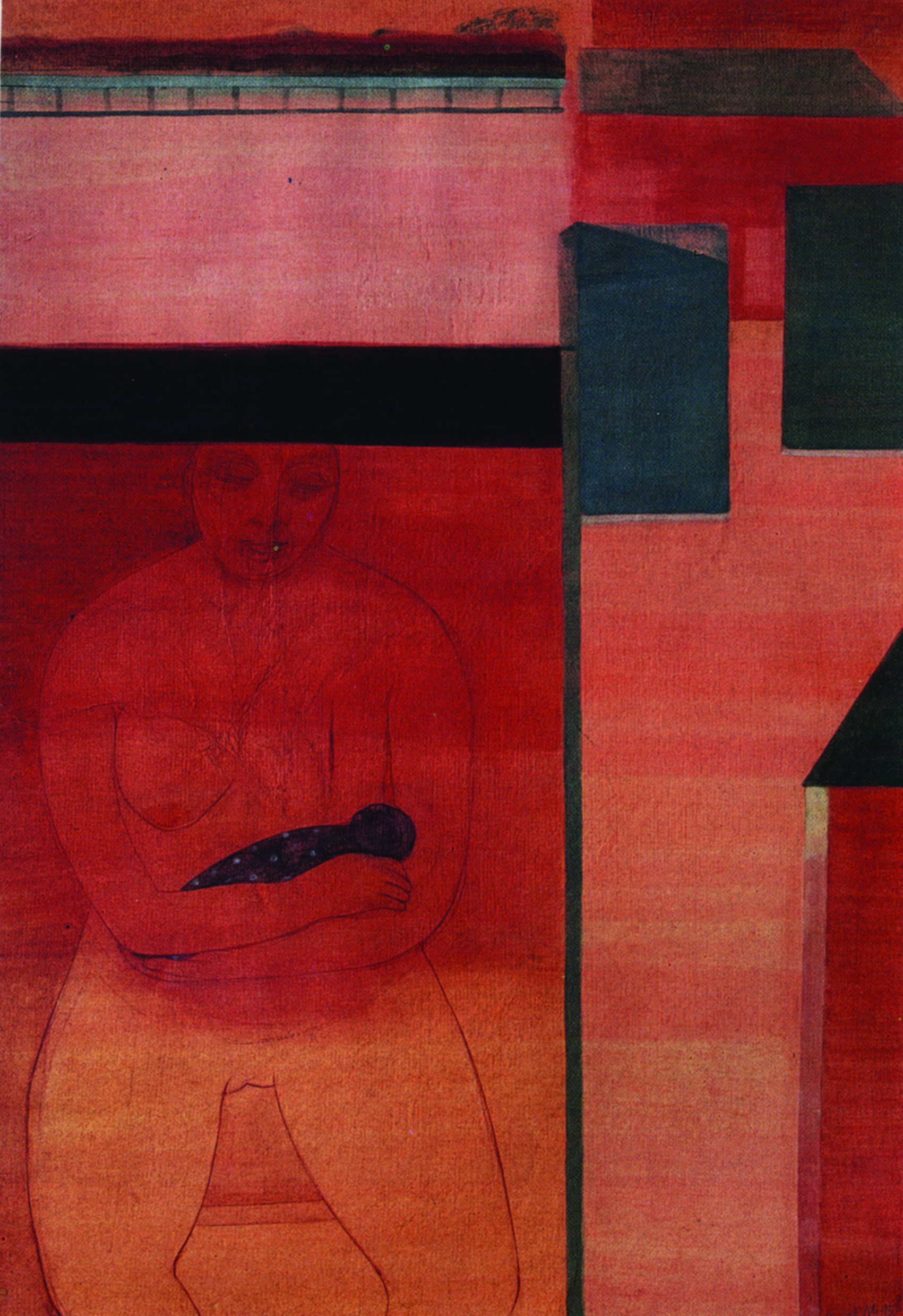
Nilima Sheikh, Post Partum-VI (1995), Mixed tempera on vasli paper, 46 x 30.5 cm. Courtesy of the Artist.
Poets and artists, each with unique locutions in their practices, are also attentive interlocutors of those they work alongside, whether that proximity is defined by sensibility or chronology. Dodiya’s work is a kind of recitation of the self, and we might read into this self a citation of the companion structures that have supported and nourished it.
At university, a beloved professor suggested we choose a ‘companion writer’, as we drafted our own manuscripts. Each of us picked a writer we felt close to, in sensibility, context, approach, or style, whose work spoke to us — and as the semesters went on, it was this companion whose work we could turn to, when we reached a block in our own. By imagining what they might do, how they might respond to the question or problem at hand, we could find our own ways forward. This is a companionship forged through imagination — which is no impersonal thing.
Dodiya’s 2018 exhibition borrows its title from Sylvia Plath’s poem ‘Mystic’: “The air is a mill of hooks — / Questions without answer, / Glittering and drunk as flies / Whose kiss stings unbearably”. Plath’s techniques of collage and jagged-edge imagery take on new dimensions in Dodiya’s paintings — in ‘Beehive’, painted on combined pieces of fabric, a branch cuts through the narrative fragments, like clock-hands bending out of shape, curling into a moon. A woman looks away from the flowers, and below her is the outside world where a lone tree stands, blurred by a curtain. The anxieties and fear built into the painting reflect the artist’s own concerns of “the private self”, and “the emotional climate (of bodies)”, but a viewer can imagine the possible presences hovering over her studio hours, such as the pieced-together fabrics reminiscent of Rauschenberg, and the flowers hanging ominously over the woman, as the sight of tulips once brought Plath too a crisis.
To return to the question of ‘care’ and ‘friendship’ articulated in curatorial writing for exhibitions, perhaps one way forward is to ask each work directly: who and what does it cite, in reciting itself? An artist’s attention to other practices, folded into their work unwittingly or otherwise, evidences the lively continuous history of imaginative companionship, across literature and the visual arts.
I wonder about the other end of the spectrum of proximity — companionship which fiercely protects each other’s aloneness, guards each other’s solitude.
Aparna
Hi Aparna,
In thinking with you, alongside the poets, artists, and artist-poets accompanying this conversation, the matrix of the lived space and friendship comes closer to a frayed fabric—its loose, irregular wefts and warps punctuated by pockets of required solitude and uncomfortable silent distances—intermittently mended and patched, with some threads still hanging loose. The volatile domestic matrix of the urban environs rendered by these artists makes space for compromise and reconciliation (Kalia) that evokes the speaker’s inner turmoil, as well as adaptation and sustenance against repressive social structures—across the spectrum of the built, the governed, and the experienced (Dharker). In these ongoing manoeuvrings and webbings, I find it interesting how a few selfhoods that are reflected in these works through formal, material (Pochkhanawala), and temporal means (Sud) often offer a reflective form and voice to another’s confrontations and experiences, where many selves enter a continuum. Isn’t the space shared between friends and companions predicated on not just understanding the other, but in the due conversations, also reckoning with the becoming of the self—one’s outlooks, tendencies, capacities, and willingness to consider otherwise?
Like generative processes of creation and cultivation whose potentials and connotations far exceed direct recipients, the works seed a shared ground that engages with everyday crises and frictions rather than distant heroic classics. One where the creators’ outlooks, experiences glossed over by normative mainstream articulations, and modes of unscrambling and exchange also extend to other readers and viewers who long to find a resonative plane; brief encounters that might serve as crucial grappling hooks. Extending the thought on companion planting systems, these forms of co-travelling and cross-pollination, working through limitations and with different abilities, offer a refuge when considering the forms of care that do exist in practices beyond the formal spheres of work and institutional mentorship.
In the anthology edited by Eunice de Souza, besides the shared year, what also piqued my attention was how the book became a platform, undertaking an exercise a bit similar to Sinha’s. The 1997 exhibition showcased works from different periods by 15 well-known women artists, and like the anthology, made no claims at being either as comprehensive as a survey or a retrospective. Group exhibitions focusing on works by women artists had been organised before. However, as made evident by Arpana Caur’s reflection on the 1997 exhibition, “it was a particular artist’s growth and development [which] has been showcased for the first time,” which made it important to note. It was equally about the trajectory as the outcome; the drifts, choices, and sustained enquiries, in their search for a vocabulary and idiom to position their observations and subjectivities. In the anthology, published, unpublished, well-known and lesser-known works, with their varied strengths, failures, and cultural resonances, were noted by de Souza’s pointed editorial voice through introductions. In the catalogue accompanying Sinha’s exhibition and her introduction, one feels proximal to the artists as they recount their thoughts on artistic journeys, selfhood, lineages, and life experiences in the first person, gleaned from conversations, essays, diary entries, and interviews.
As I sit longer with the catalogue and the anthology, the book forms open as a cross-generational and disciplinary roundtable with spells of silence and speech, looking closely and looking away, being directed and challenged, amid a growing familiarity with many practitoners, where the ‘ask of reading’ with them today, through our questions and contexts, continues to take on new configurations.
— Stuti