
Layers of cement once obscured the 16th century painted ceiling of the Sabz Burj in Nizamuddin in Delhi. Restoration work done by the Aga Khan Trust for Culture (in partnership with the Archaeological Survey of India and with the support of Havells India Limited) has revealed breath-taking compositions in gold and lapis lazuli that adorned the ceiling. A magnificent floral scheme laid over an umbrella of lapis blue, it predates Mughal painting on paper and textiles, and is among the earliest surviving Mughal wall paintings. That blue on the ceiling does something spectacular. It does not sit silently within the geometry of the dome. It opens it up. It creates the illusion of infinite depth, of the heavens within architecture. It is at once surface and atmosphere, echoing Persian poetry in allusions to the sky as a lapis lazuli dome.
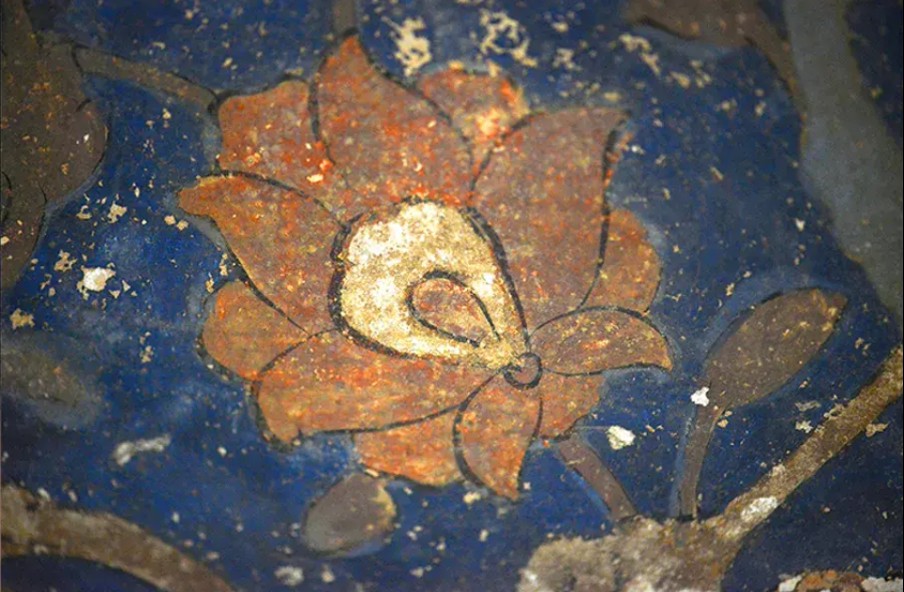
Image 1: Detail from the ceiling of the Sabz Burj painted in lapis lazuli and gold pigments. Removal of cement revealed these surviving Mughal wall paintings. Image Credit: Aga Khan Trust for Culture
It is also the culmination of several processes. What we see as a seamless field of colour is the result of mining, grinding, sorting, mixing, and layering; a transformation of stone into pigment, and pigment into paint. The Sabz Burj, in this sense, is not just a monument, it is a record of making.
Lapis lazuli, from stone to preciously prepared pigment, weaves through the history of art in the subcontinent and beyond. Its earliest appearance in the subcontinent was in the form of beads from sites like Bhirrana in the Indus Valley, small, portable, tactile, and for personal adornment. Over time, its precious blue-ness is transformed into something more ambitious. It colours the walls and ceilings of Ajanta, the cliffs of Bamiyan, the painted surfaces of Panjikent and Kizil. It moves from ornament to environment.
And yet, something of its earlier life as stone always lingers within.
To encounter lapis lazuli in art history is to invoke a story about distance. It is a material that comes from elsewhere, almost always traced back to Badakhshan in present-day Afghanistan. Its presence is often read as evidence of long-distance trade. It becomes a proxy for connection, for routes that carried goods, ideas, and people across what we now call Eurasia.
This narrative is compelling, and not without basis. Lapis does travel. It circulates across vast geographies, appearing in places far removed from its geological source, from Egypt to Mesopotamia, to the paintboxes of the Flemish masters. But to focus only on its movement is to overlook what happens after it arrives. Because lapis lazuli, as it appears on walls, is not simply transported. It is transformed. A pigment is often imagined as a straightforward mixture: mineral ground into powder, combined with a binding medium, applied to a surface. But lapis lazuli resists this simplicity. If used in its raw, powdered form, it produces a muted, greyish blue. The luminous, saturated blue we associate with lapis lazuli must be coaxed out of the stone. This requires separating the blue mineral—lazurite—from the white calcite and the golden flecks of pyrite embedded within it. It requires labour, skill, knowledge, resources, and time. The production of a bright lapis lazuli pigment is not incidental. It is a specialised craft.
Once we begin to think of lapis lazuli in these terms—not just as a material, but as a process, the emphasis shifts. The value of the pigment no longer lies solely in its distant origin, as art historian Michael Baxandall would have us believe (Painting and experience in fifteenth century Italy…, 1978), but in the craft required to make it. The blue on a wall is not just imported, it is extracted through expertise. This complicates the idea of lapis lazuli as merely a marker of trade.
Across Eurasia, between roughly the 3rd and 10th centuries CE, lapis lazuli appears in a remarkable range of wall painting traditions. It appears in the world’s first known oil paintings in Bamiyan, in the cave complexes of Kizil and Dunhuang, in the monumental Buddhas of Bamiyan, in Mes Aynak, Ajanta, and Panjikent; traces of this blue persist – sometimes vibrant, sometimes faint, but always telling.
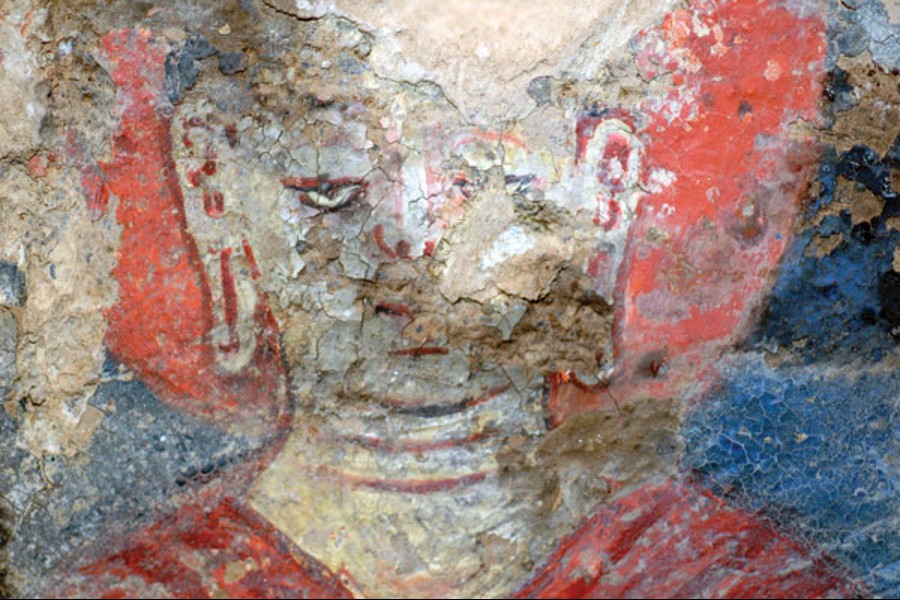
Lapis lazuli based paint used in the oldest oil paintings in the world (circa 650 CE). Detail from a series of Buddhist murals. Bamiyan, Afghanistan.
Image Credit: National Research Institute for Cultural Properties, Tokyo/Archeology Magazine.
These are not portable objects. They are fixed, architectural, embedded in place. And yet the material within them speaks of movement and alchemical transformation. This tension – between mobility and fixity – is central to how lapis lazuli has been understood. But recent research suggests that even this framing may be too narrow.
For a long time, it was assumed that all lapis lazuli used in antiquity came from a single source in Badakhshan. This assumption made it a particularly useful tool for mapping exchange networks. But newer studies point to multiple possible sources, including regions near Lake Baikal, the Pamirs, and parts of Iran, and Central and South Asia. If lapis lazuli could be sourced from different locations, then its presence alone cannot map a single route. More importantly, even when the stone travelled, the pigment did not travel unchanged.
Technical analyses of wall paintings reveal that lapis lazuli pigments were prepared and used in different ways across regions. In some cases, the pigment appears highly refined; in others, it is mixed with materials like the first synthetic pigment Egyptian blue or azurite. At sites like Dunhuang, azurite is sometimes used as an underlayer beneath lapis lazuli, extending the pigment while preserving its visual intensity. These variations are not accidental. They reflect distinct traditions of making.
The blue of Ajanta is not the same as the blue of Kizil, even if both originate from lapis lazuli. The differences lie in preparation, in layering, in application – in choices made by artists and artisans working within specific contexts. To look closely at lapis lazuli, then, is to see not just a shared material, but a diversity of practices and histories of embodied engagement with a material often valued as highly as gold. This brings us to a familiar divide in the history of art: between what objects mean and how they are made.
Lapis lazuli occupies both registers. It carries symbolic weight—associated with divinity, healing, luxury. In Buddhist traditions, it is linked to the Medicine Buddha and his luminous blue realm. It appears in medicinal and alchemical texts, suggesting that its significance extended beyond the visual. At the same time, it demands attention to process. To tools, to recipes, to labour. Holding these together is not easy. Art history has often leaned toward one at the expense of the other. But lapis lazuli resists that separation. Its meaning is inseparable from its making.
Historical recipes for preparing lapis lazuli pigment offer a glimpse into this complexity. Found in artists’ manuals, lapidaries, and medical texts, they range from the practical to the perplexing. Some describe procedures that border on ritualistic – immersing the stone in animal bile, or subjecting it to prolonged soaking in coloured solutions. Others, like the detailed account by Cennino Cennini in medieval Europe (Il libro dell’arte), outline a multi-stage process involving waxes, resins, and repeated extraction.
Interpreting these recipes is difficult. They assume knowledge that is no longer readily accessible – of tools, of measures, of materials. And yet, when they are experimentally reconstructed, they reveal something crucial: that pigment-making is an embodied skill. It cannot be reduced to instruction alone.
One of the most compelling pieces of evidence for this embodied knowledge comes from bioarchaeology. In a recent study, microscopic particles of lapis lazuli were found embedded in the dental calculus of a woman dated to the 11th or early 12th century. The pattern of deposition suggests repeated exposure, likely through pigment preparation or painting—perhaps even through the shaping of a brush with the lips. It suggests that lapis lazuli was not only traded as a material, but worked intensively at a granular level. It points to the presence of skilled practitioners engaged in its transformation. And importantly, it provides evidence—rare and tangible—of women’s involvement in this process.
Cennini’s recommendation that young women were particularly suited to preparing ultramarine has often been read as incidental. But here, it finds an unexpected resonance. The blue we admire may well have been made, in part, by women whose labour remains largely unrecorded. If we return to the painted surfaces themselves with this awareness, they begin to read differently. The blue is no longer just colour. It is the outcome of decisions—about how much to refine, what to mix, how to layer. It carries traces of local knowledge, of adaptation, of experimentation.
Similarities between sites like Kizil and Bamiyan may reflect shared techniques as much as shared iconographies. Differences may point to distinct workshops, or to itinerant artisans carrying skills across regions. The movement of lapis lazuli, then, is not just about the movement of stone. It is about the movement of knowledge.
There is also another dimension to this movement—one that intersects with medicine, ritual, and care. In several traditions, lapis lazuli is associated with healing. The Medicine Buddha’s realm is imagined as a world of lapis lazuli blue. At the same time, the material appears in medical and alchemical recipes. The boundaries between pigment, medicine, and transformative substance are porous. Those who prepared pigments may also have been involved in preparing medicines. The skills overlap: grinding, purifying, combining, transforming. To make colour, in this context, is not just a technical act. It is part of a broader practice of working with materials to alter their properties and by extension, their effects.
To write about lapis lazuli is to move between scales. From the geological-mountains and mines – to the microscopic particles lodged in teeth. From vast networks of exchange to the intimate gestures of hands at work. From symbolic meanings to material processes. The blue of the Sabz Burj ceiling contains all of this. It is at once distant and immediate, abstract and intensely physical.
When we look at it, we see colour. But we are also seeing labour.
Grinding. Sorting. Mixing. Applying.
Perhaps, also, the quiet persistence of those who made it—whose work survives not in names or records, but in the density of the colour itself.
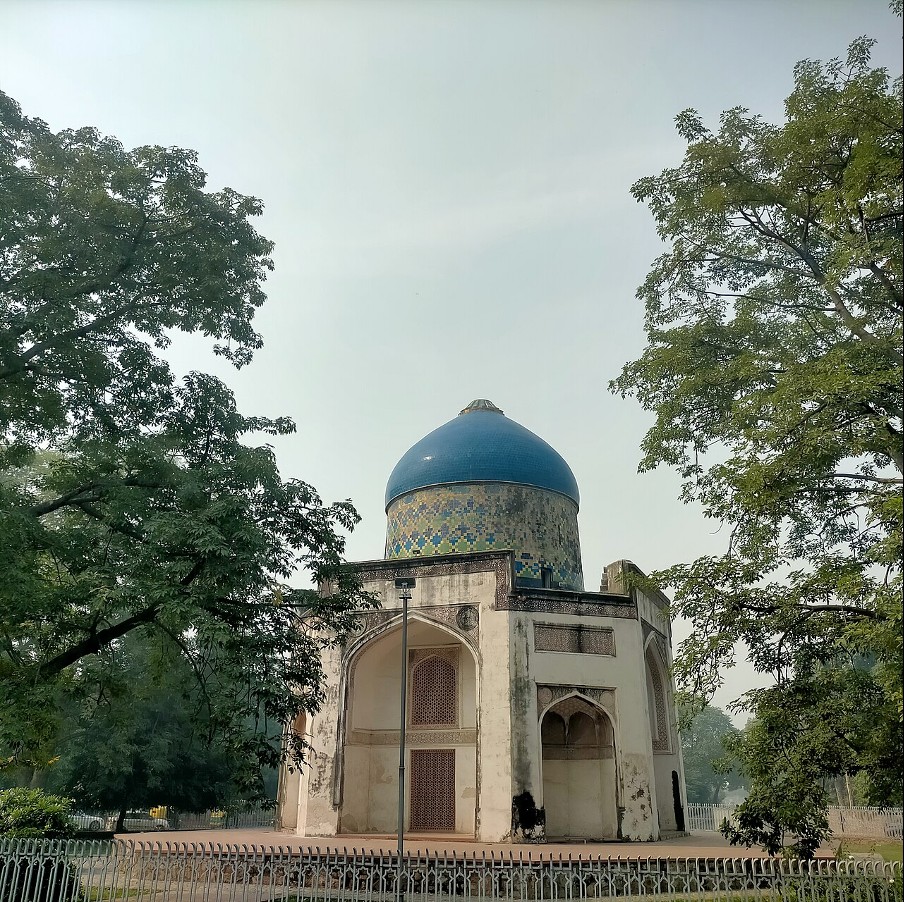
Sabz Burj (“Green Dome”) is an octagonal tomb situated in Mathura Road, near Nizamuddin complex, beside Humayun’s Tomb, New Delhi. Image Credit: Aliva Sahoo, through Wikimedia Commons
