
When I came back from US I knew nobody in Sri Lanka. I first started painting seriously while we were there and I also had my first solo exhibition while Sasanka and I were in Santa Barbara.1 I started going to exhibitions at the newly opened Heritage Gallery in Colombo that exhibited contemporary art and that is where I met Chandragupta Thenuwara and Jagath Weerasinghe.
Thenuwara and Weerasinghe were the two senior artists, both established art teachers with reputations of being radical in their teaching methods. They had gathered a group of aspiring young artists around them who wanted to break away from the way art was being practiced in Sri Lanka. “I was the only outsider in the group and the only woman,” Parera says, laughing. “We decided to hold our first exhibition together as a group in the late ‘90s and decided to bring out a manifesto to explain to our critics that we were not interested in producing ‘authentic’ Sri Lankan art but wanted our work to reflect the reality of our society still recovering from the long years of civil war. We called ourselves the No Order Group. ”
Parera was referring to the famous ’43 Group who brought modernism to Sri Lankan art by turning away from the academic realism of the colonial era. Inspired by movements such as Cubism, artists like George Keyt portrayed scenes of rural life, and themes inspired by mythology that were considered to be authentically Sri Lankan. The artists of the ‘No Order Group’ and others of what is now known as the ‘90s trend artists, adopted a self-conscious stand against this mode of essentialisation by addressing the contemporary political issues that were impacting their everyday lives. In Sri Lanka the decades of the 1970s and 80s were marked by civil strife caused by anti-state rebellions, first by the Janata Vimukti Perumana and then by the Liberation Tigers of Tamil Elam, which was finally put down by the state in 2009 (Parera 2011). While Parera and some other members of the group may not have witnessed the violence at first hand, they did experience its effects in the form of religious and ethnic polarisation and chose to express their critical engagement with Sri Lankan politics through their art. Some adopted an aesthetic of ugliness, while others chose to turn away from paint and canvas and use unconventional media such as newspaper, waste material etc.
Anoli Parera’s interest in multi-media work also began around this time though it achieved its full development when she started creating large installations. “ I think of myself as a bricoleur,” she said. “I never throw anything away – odd scraps left over from my mother’s rag basket, thoughts that I sometimes scribble on bits of paper – they all find a place in my work. That’s why I love installation work. It allows meaning to expand. There is more room to explore ideas.” The installations that I explore in this essay are from two series – Comfort Bodies and Memory Keepers – both of which engage with ideas of loss, memory and the ageing body.
Time and Memory
A canopied bed with a trunk resting in the middle with a TV screen on top; messages in bottles arranged in neat rows in front of the flickering screen, partially obscured by a lace veil that covers it- the installation enmeshed with panels of white crochet lace. Rose patterned screens imprinted with old fashioned black and white portrait photographs surround the installation.
These were some of the assorted artworks displayed in Anoli Parera’s first solo exhibition in New Delhi, held at the Shrine Empire gallery in 2013. In an interview to mark its opening, Parera described herself as a “memory keeper – born wedged between the sunset of one era and dawn of another. My parents grew up in an era of missionary schools… our neighbours were Burghers2 and we played with their children. But we lost the Burghers by the end of 1979 as a wave of ethnic nationalism swept the country after independence and the Tamils by 1983. We also lost a part of our cosmopolitan culture. And in the thirty years of civil war, at the time when my generation was growing up, we lost our innocence.”3
While being an intensely political artist Parera’ work eschews the grand gestures of interventionist art. Her political statements are expressed in her choice of materials, in the presentation of objects that are shaped by their absorption of pastness and their potential to allow recollection. The message lies in the way the work is assembled – in the reflexive relations between its different parts, none of which can be firmly related to a single referent leading to ambiguity and multiplicity in meanings.
Left Behinder, the exhibition’s show piece consisting of a canopied bed entombed within walls made up of crochet panels is a visual representation of a poem by Jean Arasanayaga, a Burgher poet now exiled from his homeland. The poem itself is embroidered on the bedcover and the screen that sits on the middle of the bed projects a video depicting a Burgher woman searching for relics of her past – old photographs, recipes and a doll that had been left behind when she had to leave her home and her country. The mysterious rolls of paper in the plastic bottles, neatly arranged at the foot of the screen, are recipes of Burgher dishes that Parera relished as a child.
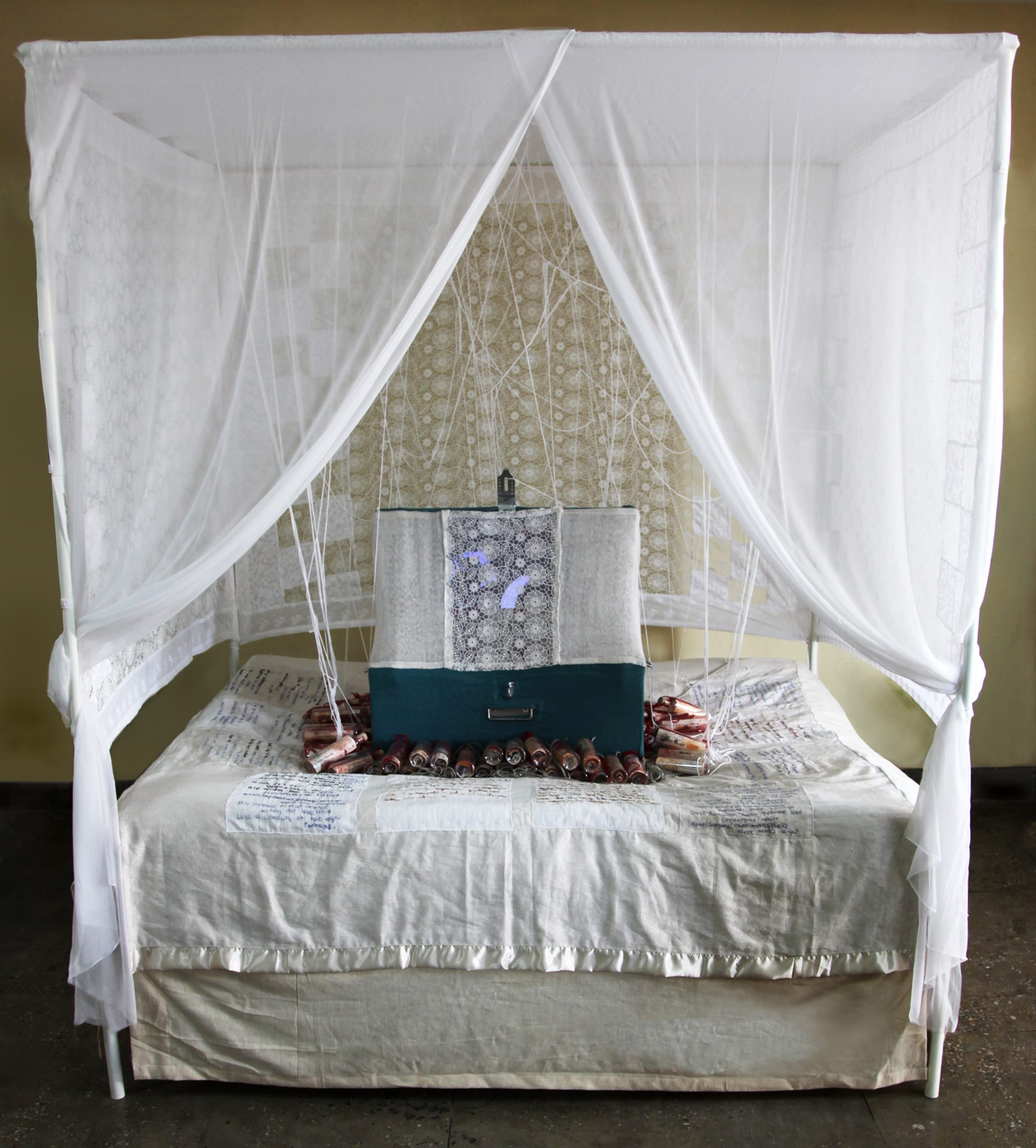
Anoli Perera, Left Behinder: Bed, 2013, Iron bed, mattress, bedcovers, metal trunk, lace panels, cloth canopy, wool thread, plastic bottles, LED screen, DVD player, video “Last Doll”, Duration 3.16 minutes (on a loop), Embroidered poem Left Behinder by Jean Arasanayagam. Image Courtesy of the Artist and Shrine Empire Gallery.
The Silent Sitters, a furniture themed series, consists of carved chairs, a cupboard and a chest, all covered with stuffed brocade balls in which are embedded minute photographs depicting scenes of everyday life from a bygone era, scenes that had to be viewed with the aid of a magnifying glass. “These chairs served as theatrical props in the staged portrait photographs of our old relatives”, she said. “They have become relics, residues of history and fetishistic objects of our nostalgia.” Indeed, memories, encrusted in the stuffed cotton balls seemed to body forth from the chairs, reaching out in an attempt to claim the viewer’s attention in marked contrast to the still presence of the carved, hard backed chairs and heavy wooden cupboards.
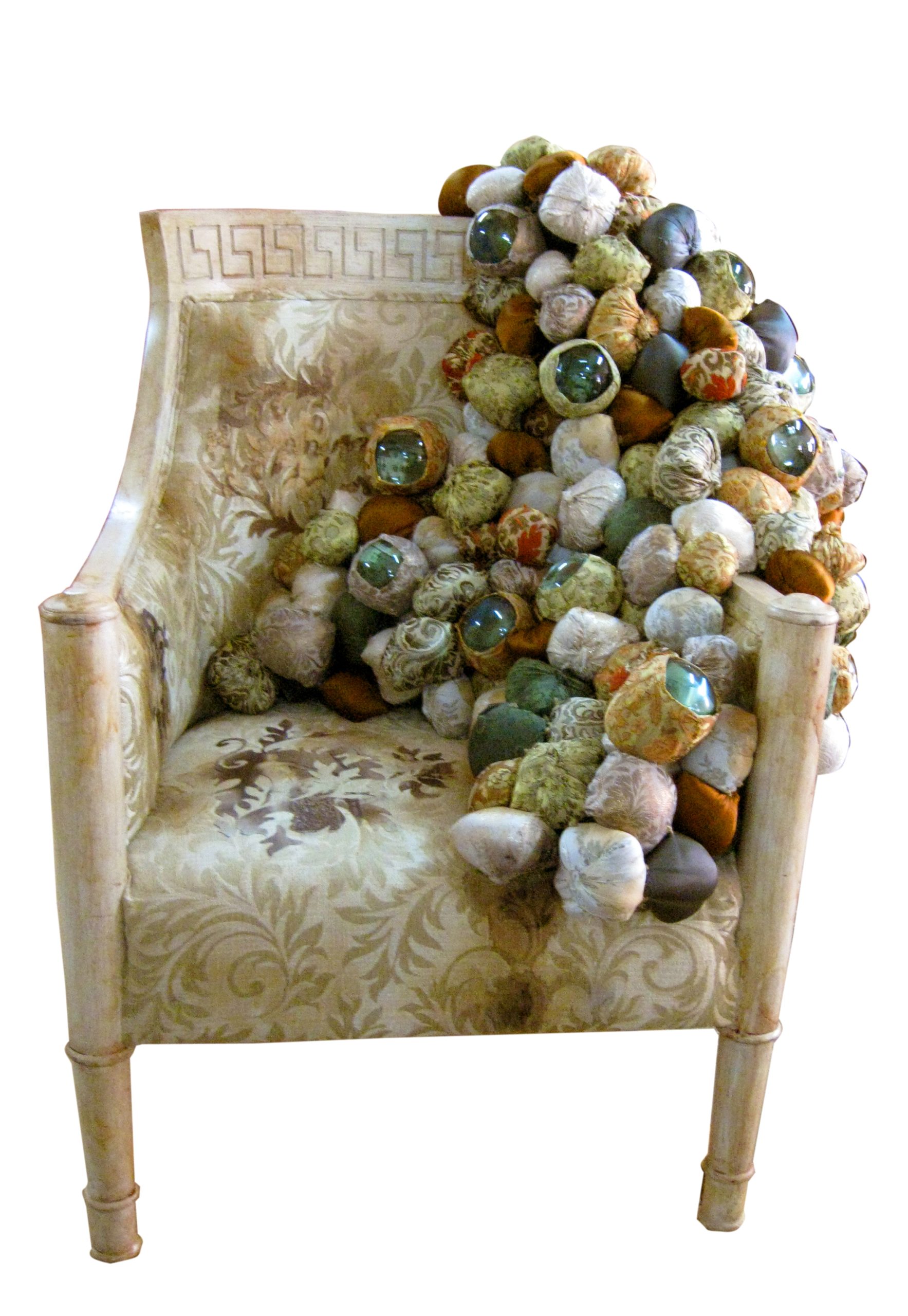
Anoli Perera, The Silent Sitters – Chair Series I, 2013, Wood, clothing, stuffing, images and magnifying glass. Image Courtesy of the Artist and Shrine Empire Gallery.
Each one of these installations is made up of an assemblage of different objects and materials – photographs, pieces of writing, wall paper with floral patterns, fabric and furniture. They all condense meaning and memory in highly personalized ways, ways that may be unknown to the viewer who must find their own way into these artworks. It is the very indeterminacies of interpretation that arrest the viewer’s attention.
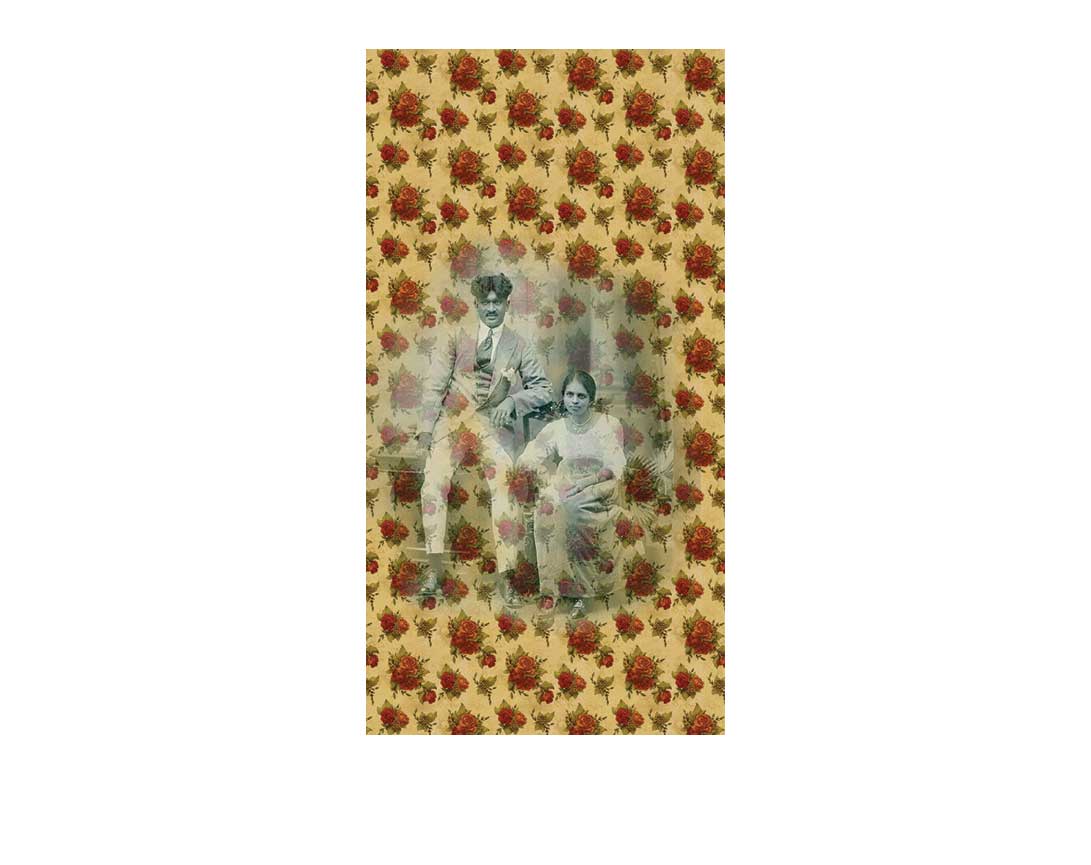
Anoli Perera, Rose Wallpaper Series II, 2012, Print on Hahnemuhle archival canvas. Image Courtesy of the Artist and Shrine Empire Gallery.
The Maternal Body
Female torsos, flabby skin covering bulging bellies and sagging breasts – the texture of ageing skin lovingly conveyed through a patchwork of multicolored fabric stretched over headless mannequins. The Comfort Bodies series (2007) portrays the ageing body of the mother. In her concept note for the exhibition Parera wrote that throughout her artistic career her mother’s body remained an object of fascination – its monumentality and uncompromising shape marked, by repeated childbirth, nurturing and the pain of loneliness once the children had flown the nest. Interestingly it is through fabric that she is able to evoke the tactile effect of this body. Her later installations – series such as Measured, Stitched and Stretched (2009-10), Monumental Dress (2011) and Second Skin (2010-2012) explore other aspects of the woman’s body through everyday intimate objects used to adorn or rather confine her woman’s body. Dresses composed of interlinked safety pins evoke the ‘ideal’ form of the eroticized feminine figure and contrastingly elastic bra straps and loops that are interwoven to construct the scarlet flood of the menstrual flow – both celebrate and acknowledge biological change and renewal but also point with lingering regret to the “shroud” that forms the second skin that women are forced to wear in public to appear feminine to the patriarchal gaze.
It is in these installations that Parera’s feminist voice appears most clearly to my mind, not so much as an explicit form of messaging but rather through the subtle play of symbols. Her adroit use of metaphoric tropes was already evident in one of her early exhibitions, The Vehicle Named Woman (1998), where scrap metal sourced from discarded motor cars became the canvas on which she painted but it is in these later installations that we see a more nuanced use of ellipses through the interplay of metaphor and metonymy as she translates poetic tropes into visual imagery.
The maternal thematic is found in multiple forms in art as well as in scholarly literature. Beginning with Jungian representations of the archetypal “Great Mother” to more recent psycho-analytical works by feminist scholars it is the body in its dual aspect of surface and depth that is privileged. The bulging torsos in the Comfort Bodies Series of sculptures recall the faceless fertility figures with their gigantic breasts and bellies that symbolize the maternal body as a sacred vessel celebrated as the Magna Mater archetype by Jungian scholars (Neumann, The Great Mother: An Analysis of the Archetype, 1963). The display of naked flesh emphasizes the dual aspect of the maternal body – the outer surface pointing to the creative inner realm.
The artist-scholar Elizabeth von Samsonow (Anti-Electra: Totemism and Schizogamy, 2010) elaborates on the dual aspect of the maternal body – experienced both from the inside as well as the outside. Thus for the child in the womb the mother has no exteriority, no face. She is an all-encompassing container. But later, after the child emerges from the womb, the mother turns herself inside-out like a Mobius strip. She presents her external surface, her face to the child. The body turned ‘inside-out’ is a recurrent refrain in Parera’s oeuvre – playfully parodied in the Woman as Vehicle Series and with more emotional intensity in the giant multi-wombed sentinels that are part of the Ghosts of Swarnabhumi Series.
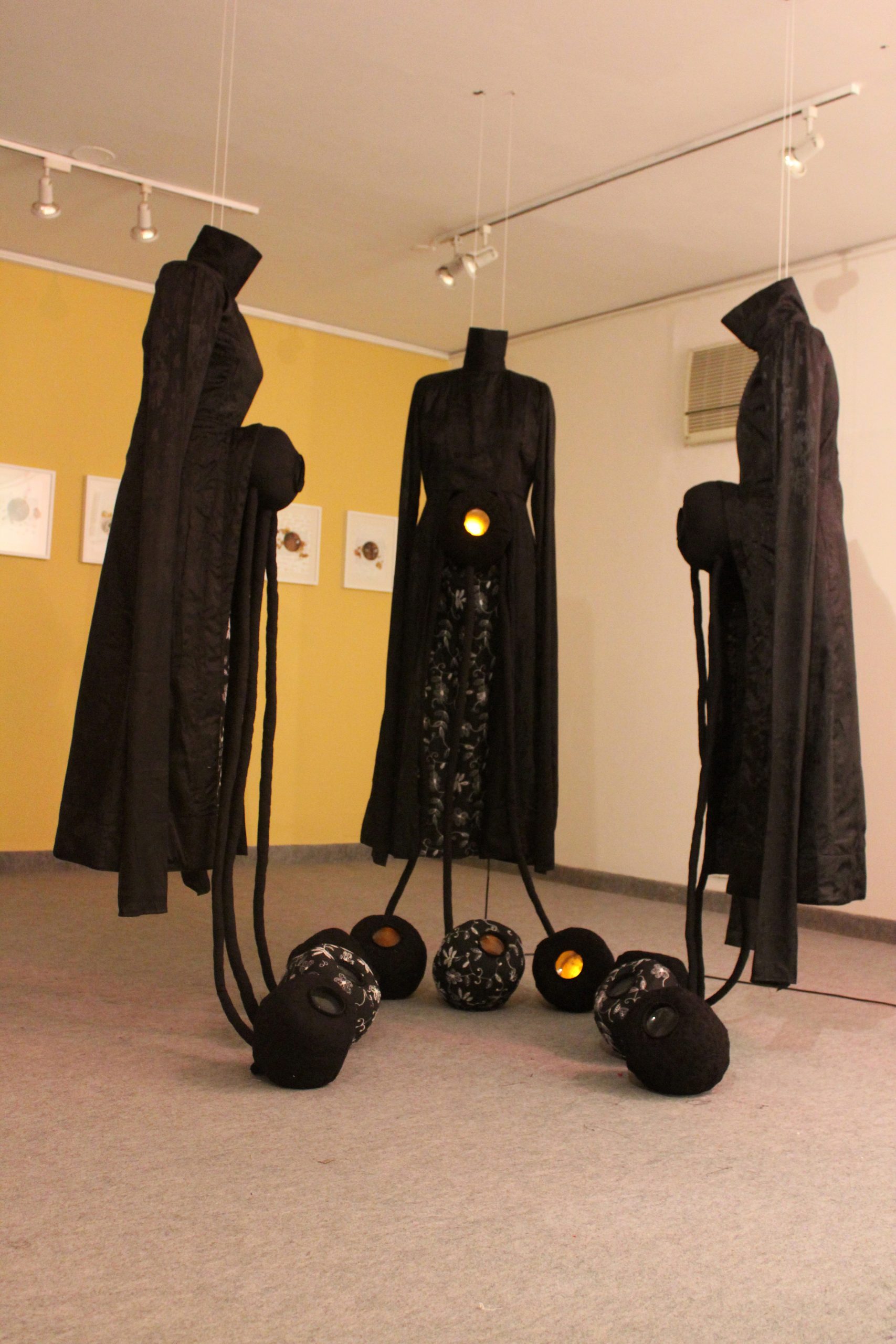
Anoli Perera, Ghosts of Swarnabhumi 3, 2013, Image Courtesy the Artist.
Apart from the body as a vessel, ‘inside-out’ points to a space – an inner space that also lets itself be seen from the outside. Many of Parera’s installations take the form of built interior spaces – beautifully apportioned rooms with walls of gossamer lace through which viewers are invited to look inside, to view objects that seem to belong to Parera’s own childhood invoking memories of Burgher neighbours and scenes of domesticity. The crocheted panels that Parera uses to evoke the inside-out effect were created by the women in her family – needlework being an accomplishment that was part and parcel of the identity of a well-groomed Sri Lankan woman. But domestic skills such as crochet are part of the colonial legacy – a skill brought to Sri Lanka by outsiders.
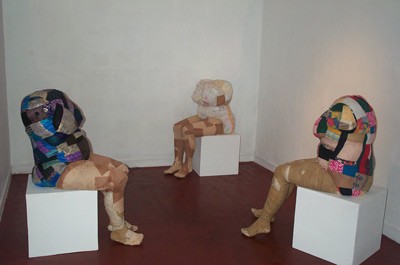
Anoli Perera, Silent Grievers (2007) Cloth, stuffing, wire frame and fibre, Image Courtesy the Artist.
Anoli Parera is a bricoleur as I have previously mentioned. She builds her works by using what she describes as the “debris of events”. She orders and reorders images and materials recycled from previous works. According to Levi-Strauss (The Savage Mind, 1972) the means that the bricoleur uses for her creations are determined by their potential, by the actual and possible relations they seem to suggest. As an artist Parera speaks through the medium of things – through the fragments left behind from previous usages putting something of herself, her family and her country in each one of her compositions.
Footnotes
1. Anoli accompanied her sociologist husband Sasanka Parera to Santa Barbara, California where he was a PhD student. She was studying hotel management at that time but gave it up to practice art. Santa Barbara and later Princeton gave her the space to experiment with painting and sculpture. She is primarily a self- taught artist though she did take short term courses in art and sculpture while in the US.
I Interviewed Anoli and Sasanka Parera on 25th November 2023 in Delhi.
2. Descended from mixed marriages between Sri Lankans and Europeans (Portuguese, Dutch and English) who settled in Sri Lanka during the colonial period the Burghers are a distinctive ethnic and cultural group though with a fast diminishing presence in Sri Lanka.
3. The Memory Keepers_Unboxed Writers. Interviewed by Poonam Goel and posted on 18.12.2012. http://unboxedwriters.com 2012/12/the-memory-keeper.