
In the histories of post-Independence Indian sculpture, the dominant narratives of modernism have often privileged monumentality, nationalism, and masculine sculptural authority. Yet such frameworks have left comparatively little room for practices that pursued abstraction through more intimate, ecological, and materially responsive means. Among the artists who complicate this genealogy is Latika Katt (1948–2025), whose sculptural language rooted in forms derived from trees, roots, bark, seeds, and the latent life of organic matter constitutes one of the most compelling yet underexamined practices in late twentieth-century South Asian sculpture. Katt elaborates:
“I have been interested in insects and insect life. Termite and termite hills, bees and beehives, making of cobwebs are all so fascinating! Their life patterns and forms are always ever-growing and ever-changing. The strength in the finest strings, despite the length, the perfect modelled curves of the ant hill interiors and the perfect geometry of the wasps dwelling are simply amazing. Over all these years, the assimilation of these varying shapes has formed an emotional chord with me. I live with these tangible shapes and they are an integral part of my concept and creativity.” — Latika Katt, Metaphors of the Inner Realm
To revisit Katt today is to recognize her not merely as an accomplished sculptor working within inherited modernist vocabularies, but as an artist who transformed those vocabularies through an ecological sensitivity to growth, interdependence, and material becoming.Katt’s sculptures resist the rigid distinction between abstraction and figuration that has long structured the historiography of modern sculpture. Her bronzes, terracottas, and mixed-media works frequently oscillate between botanical, geological, and bodily associations: a twisting vertical form may evoke both trunk and torso; a swelling bronze may suggest simultaneously seed, embryo, and boulder. In Katt’s words:
“My sculptures are not illustrative. Each sculpture is a complete, abstract combination and culmination of many stages of the moving landscape. Each sculpture is like a still shot of a particular moment, of one or a cluster of shapes.” — (Ibid)
These are not sculptures that represent nature from a distance. Rather, they seem to emerge from within natural processes themselves. In Katt’s hands, form appears to germinate, proliferate, and weather. Her sculptures seem less made than grown.
This sensibility was not incidental to her practice. Working from her studio Vriksha Chhaya literally “the shade of the tree” Katt developed a sculptural philosophy grounded in close observation of vegetal life, environmental rhythms, and organic morphology. The studio’s very name offers a conceptual key to her oeuvre: sculpture, for Katt, was not an act of imposing form upon inert matter, but of working in proximity to living systems. Trees, roots, and seeds were not motifs to be translated into sculptural idiom; they were structural principles through which sculptural thinking itself became possible.
To describe this language is to encounter what may be called ‘organic monumentality’: a sculptural mode in which monumentality is achieved not through scale or heroic rhetoric, but through the slow, accumulative force of organic growth. Katt’s works possess a grounded expansiveness. They rise vertically like rooted presences, swell with internal pressure, or twist upward with the tensile energy of climbing vines. Their surfaces often retain rough, bark-like textures, preserving the tactile memory of their making while evoking erosion, weathering, and the passage of time, seen in Growth made from terracotta and Landscape made with a mix of bronze and wood. Monumentality here is not architectural or commemorative; it is ecological.
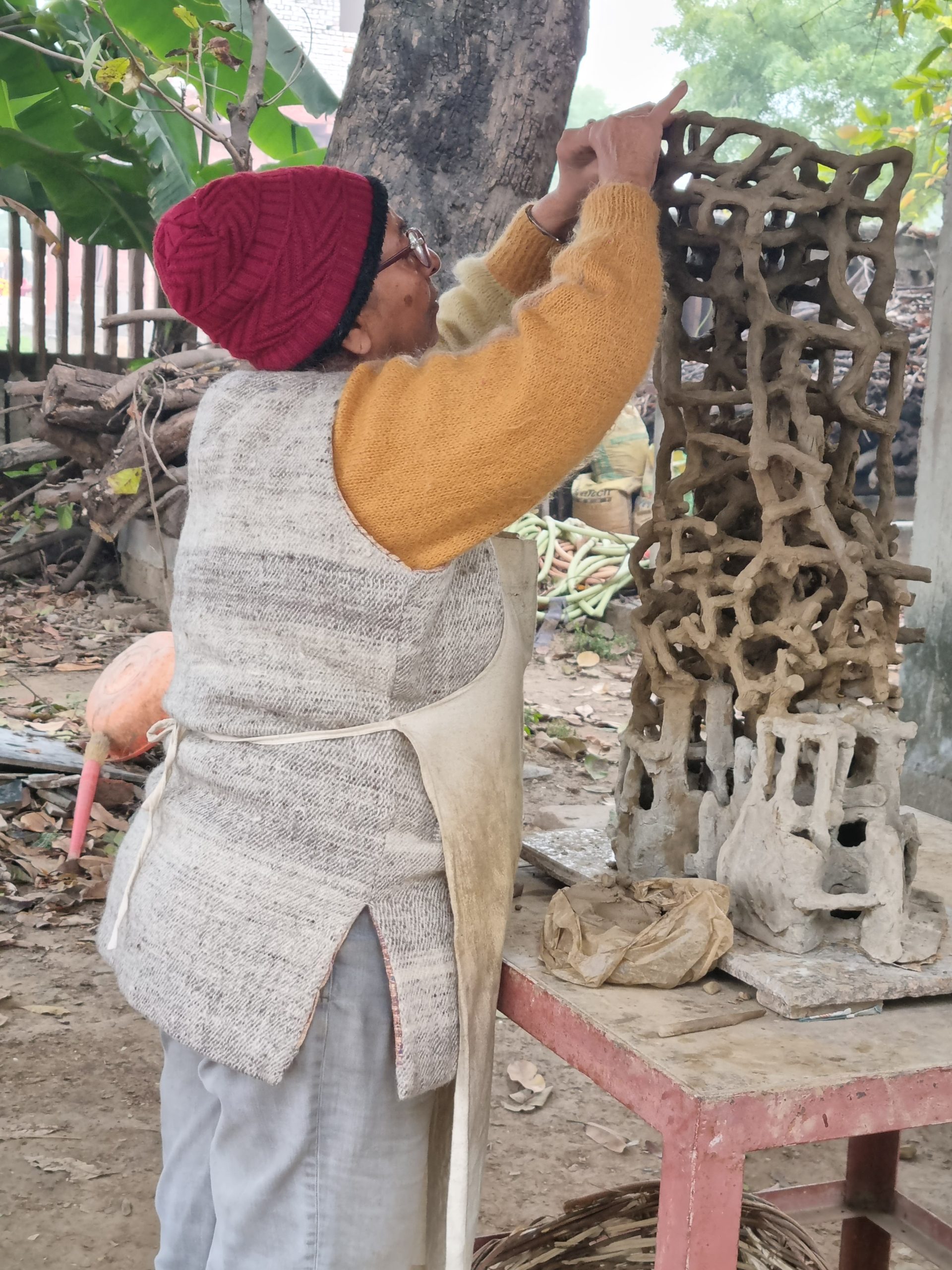
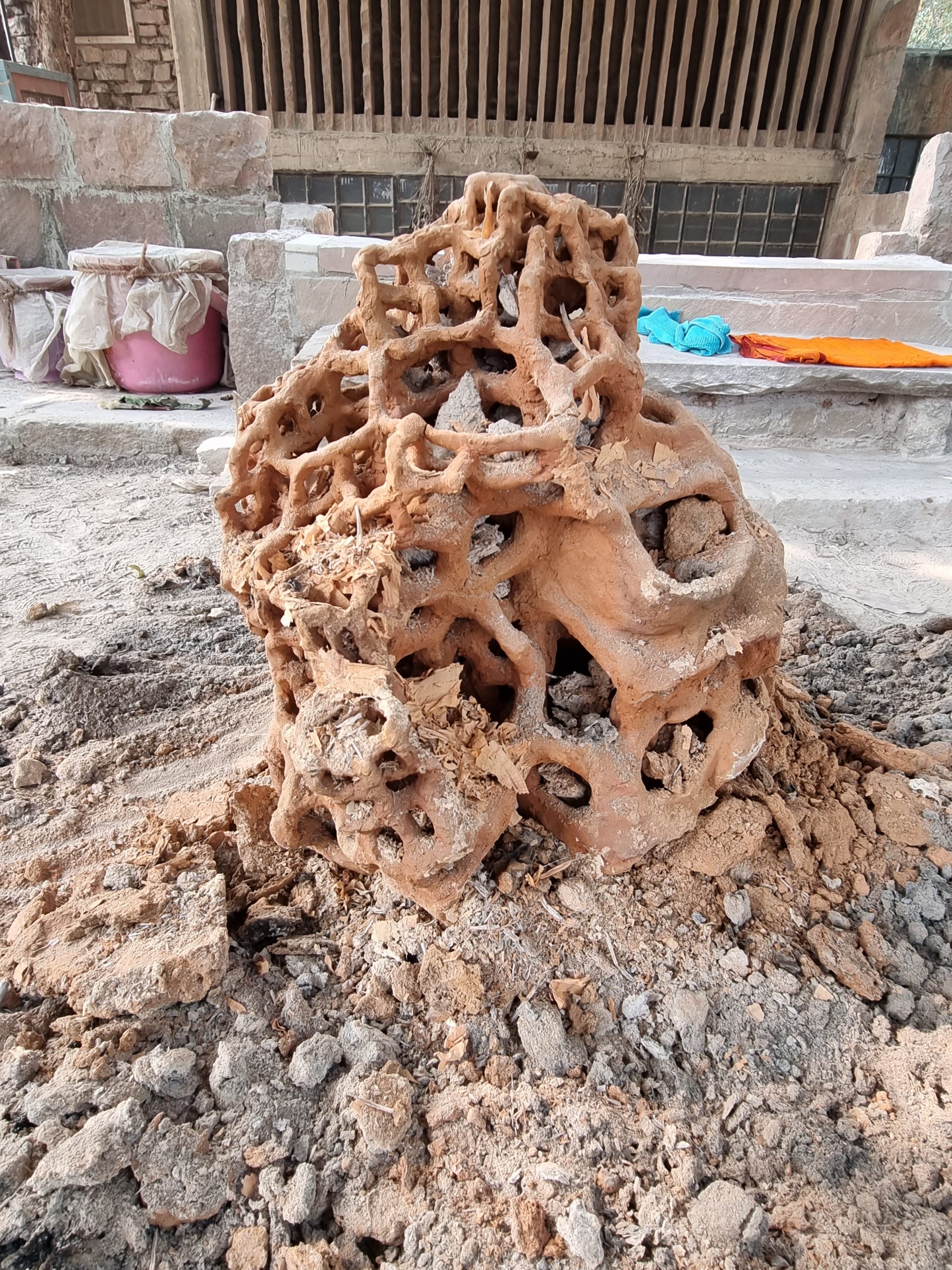
Fig 1 and 2. Growth by Latika Katt, Terracotta, From earth and touch, Latika Katt coaxes ‘growth’ into form — shaping clay as though it were a living root system finding its way through time., Images Courtesy Latika Katt Estate.
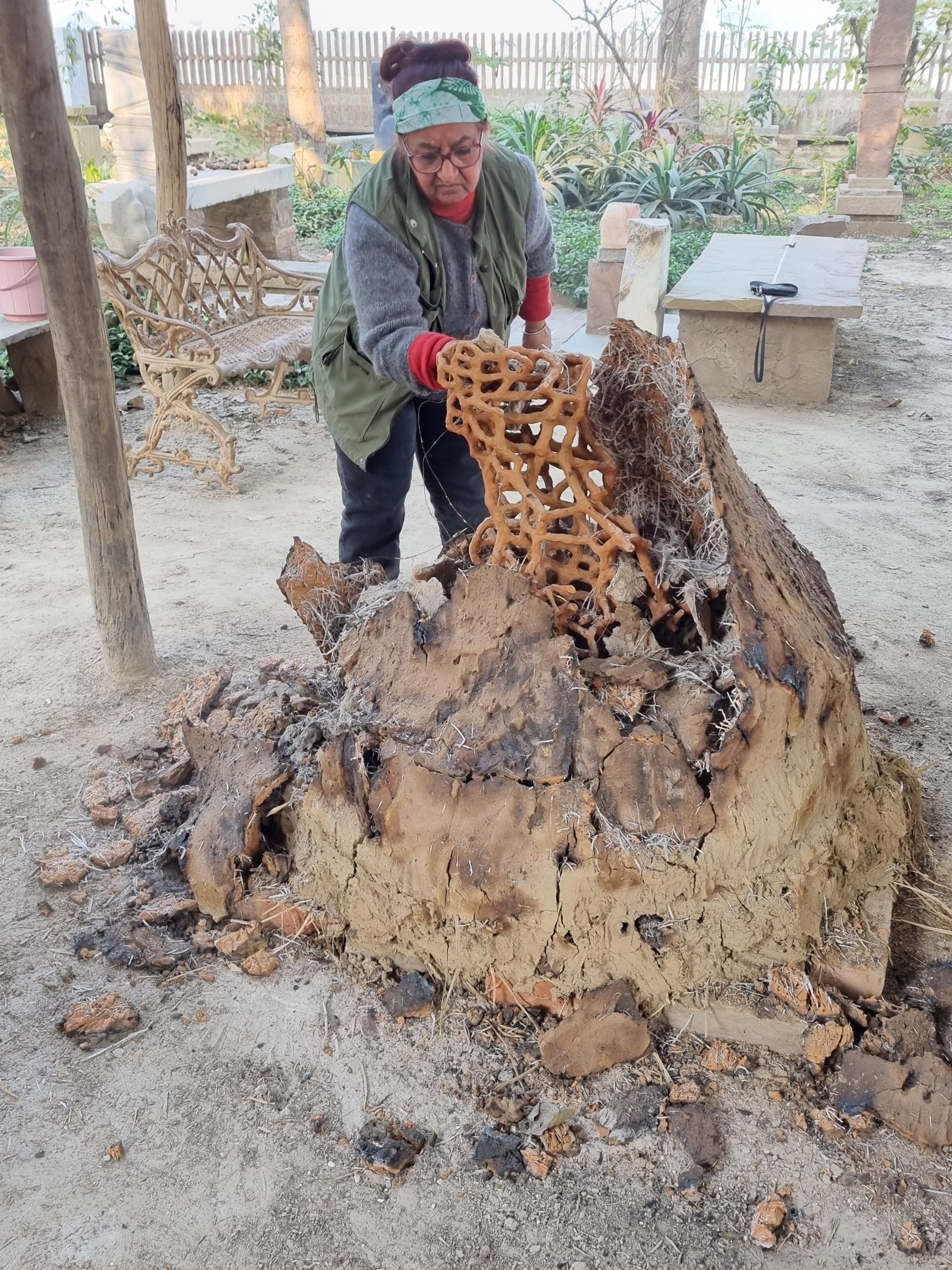
Fig. 3. Growth by Latika Katt, Terracotta, As the earthen furnace is broken open, the fired terracotta form slowly reveals itself, Image Courtesy Latika Katt Estate.
The significance of this language becomes particularly apparent when placed against the broader sculptural landscape of the 1970s and 1980s, a period during which the influence of Henry Moore circulated extensively through Indian art institutions, exhibitions, and pedagogical discourse. Post his death in 1986, Moore’s 1987–88 travelling exhibition in India Working Model: Bronzes and Graphics marked a pivotal moment in this reception history, consolidating his status as an emblem of international sculptural modernism. This show travelled across eight venues spanning the length and breadth of India from Chandigarh to Madras. As art historian Paul Overy has argued, Moore’s biomorphic abstractions were not merely formal innovations; they carried the symbolic weight of post-war British modernism, articulating a language of organic abstraction that was deeply entangled with industrial modernity, imperial soft power, and the cultural diplomacy of the British state.
Katt was acutely aware of Moore’s significance. She wrote the lead essay, titled A Discourse on Henry Moore, for the catalogue accompanying the Indian exhibition of his work in 1987. Her careful and attentive reading of Moore’s sculptural practice, praised his capacity to distill natural forms into monumental abstraction, emphasising on the totality in his sculptural work, while noting the emotional and physical charge of his surfaces and masses:
“In the Two Piece Reclining Figures another limbless form evolved which looks more abstract although it is landscape like and less representational. This is where more than one element is combined into a total sculpture. These shapes physically separated from each other, hold the space inbetween. The enclosed space and the forms bring a sense of compactness and oneness. In Moore’s compositions of this kind, despite the varying outgoing vital movements and tensions with many juxtaposed forms, the oneness of the total space is never lost. This I believe is an original approach that opened a new dimension to sculpture from which many sculptors have benefitted.” —- Latika Katt, A Discourse on Henry Moore in Working Model: Bronzes and Graphics, 1987
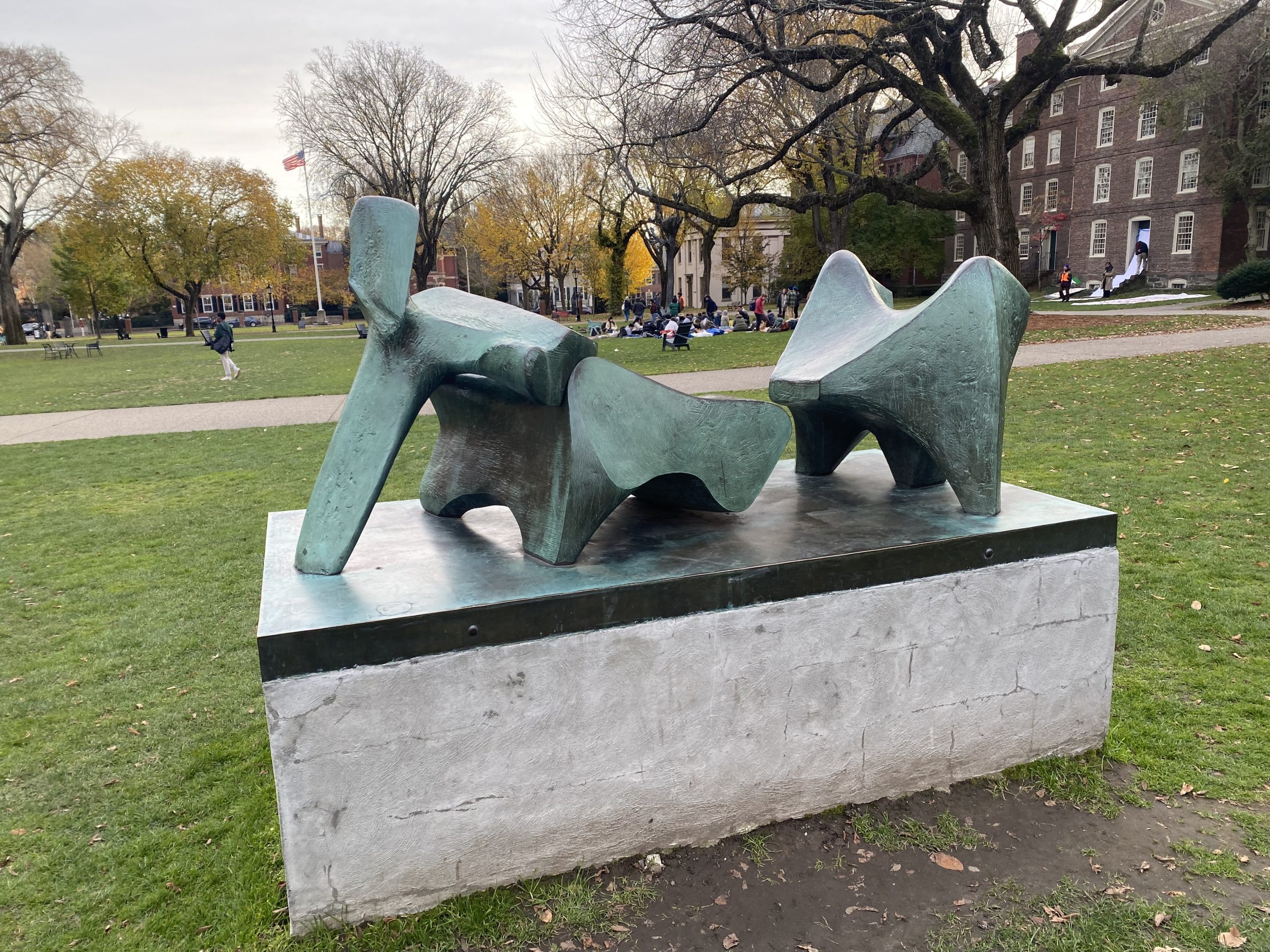
Bridge Prop, Henry Moore, 1963, Brown University Campus, Main Green. Photo: Nainvi Vora
She was especially attuned to his transformations of the body into landscape and his ability to derive abstraction from observation rather than stylization. Yet it is important to note that Katt’s own work does not simply inherit Moore’s biomorphism. Instead, it absorbs his sculptural vocabulary only to redirect it elsewhere. Where Moore’s abstractions frequently monumentalize the human body through analogy to landscape, Katt’s abstractions dissolve the distinction between body and ecology altogether. Her forms do not analogize nature; they inhabit it. If Moore’s reclining figures become hill-like, Katt’s sculptures often bypass the anthropomorphic altogether, grounding themselves in vegetal, arboreal, and germinal structures. Even when her forms suggest the body, they do so as if the body were itself part of a larger ecological continuum—one organism among many within a network of shared morphologies.
This shift is visible in works that take root-like or branching forms, where bronze and terracotta seems to twist upward with the tensile force of subterranean growth. In such sculptures like Growth and Landscape seen earlier, negative space functions not as the heroic puncture or structural revelation celebrated in Moore’s discourse of the “hole,” but as interstitial breathing space—gaps through which forms proliferate, connect, and branch outward. Katt’s sculptures are less concerned with the self-contained object than with relationality: each protrusion, cavity, or extension suggests the possibility of further growth beyond the visible edge of the form.
Her sensitivity to process is equally crucial. Katt’s surfaces are rarely polished into modernist purity. Instead, they retain the textures of bark, earth, cast residue, or hand-modelled clay, foregrounding the material memory of touch. These surfaces insist that sculpture is not an abstract formal proposition but an encounter between hand, matter, and environment. In this sense, Katt’s practice destabilizes the modernist fantasy of sculptural autonomy. Her works do not aspire to separateness from the world; they remain insistently entangled with it.
This entanglement finds a striking visual analogue in Jyoti Bhatt’s 1975 portrait of Latika Katt, preserved in the Asia Art Archive. In the photograph, Katt’s body appears partially submerged within stacked sandbags or sculptural material, her hands and face emerging from the mass, like a figure in metamorphosis.
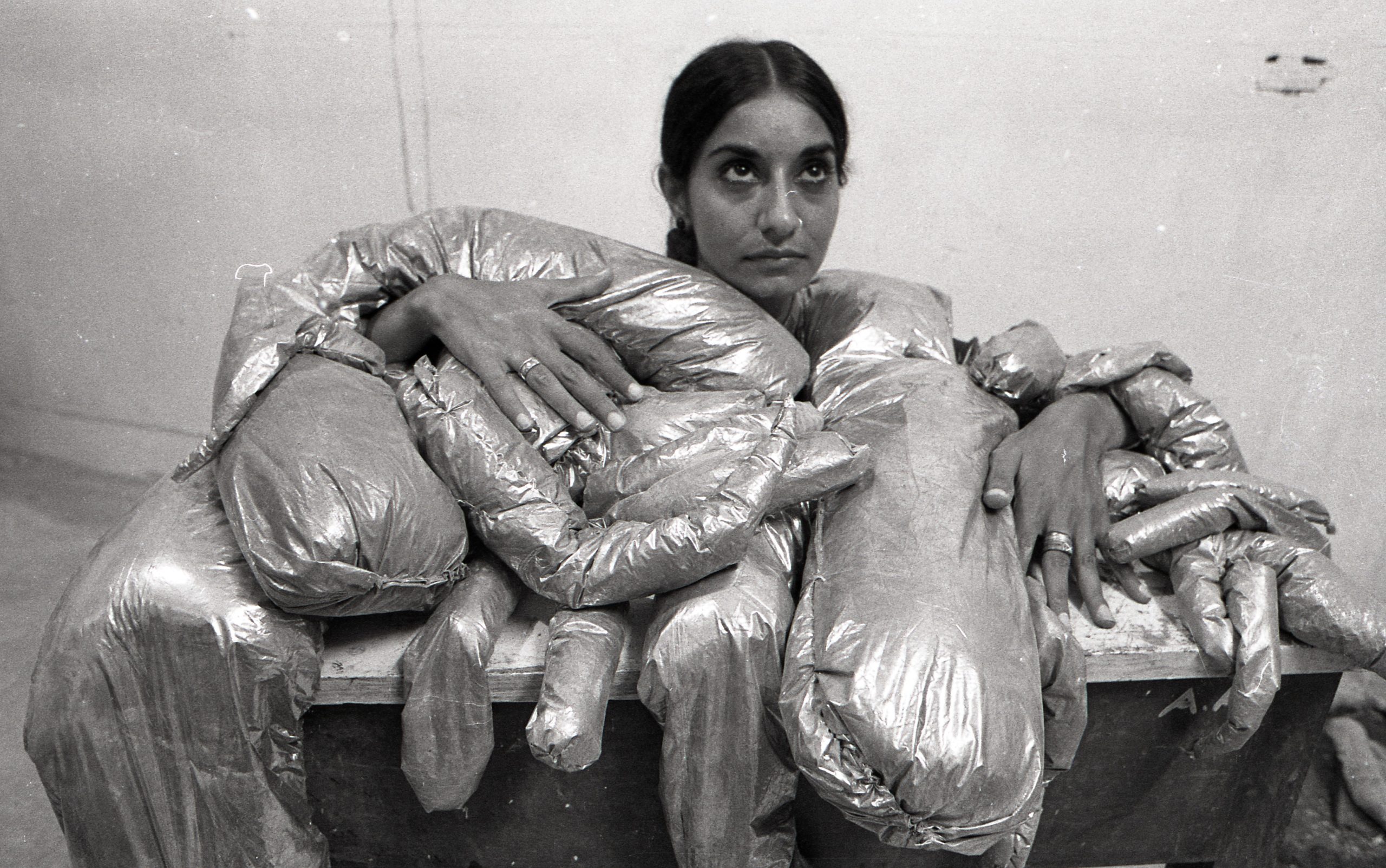
Photograph of Latika Katt in the Faculty of Fine Arts, Maharaja Sayajirao University, Baroda, Photograph: Jyoti Bhatt, 1975, Image from Jyoti Bhatt Archive. Courtesy of Jyoti Bhatt and Asia Art Archive.
Her upward gaze is theatrical, even visionary. Rather than presenting the sculptor as detached maker, the image stages her as embedded within matter itself as if artist, material, and sculpture are all part of one evolving organism. The portrait offers a powerful visual metaphor for Katt’s practice: the sculptor is not external to the material world she shapes but already within it, enmeshed in its processes of growth and transformation.
Though her work has not always been discussed through explicitly feminist terms, her sculptural method offers a compelling challenge to masculinist models of sculptural mastery. Rather than dominating matter, Katt collaborates with it. Rather than extracting form from material through force, she cultivates form through responsiveness. Her sculptures emerge through attentiveness rather than conquest.
This orientation resonates with Leela Gandhi’s notion of postcolonial “affective communities,” which describes ethical and political affiliations formed through modes of care, proximity, and relationality rather than domination. Read through this framework, Katt’s sculptures may be understood as material propositions for alternative forms of relation: between human and non-human, artist and material, object and environment. Her practice imagines sculpture not as inert objecthood but as a site of ecological companionship. Similarly illuminating is Donna Haraway’s concept of sympoiesis “making-with” which opposes autopoietic fantasies of self-contained systems. Katt’s works seem profoundly ‘sympoietic’. They do not present themselves as singular autonomous forms but as assemblages of interacting forces: vegetal memory, geological density, bodily gesture, and material resistance. Their organic abstraction is not reductive but accumulative. Each sculpture appears as the temporary gathering of multiple agencies rather than the finalized statement of singular authorship.
This is where Katt’s importance to the sculptural histories of the Global South becomes especially clear. Her work offers an alternative genealogy of modernism one that neither rejects international abstraction nor passively reproduces it. Instead, Katt localizes and transforms modernist sculptural vocabularies through ecological knowledge and situated observation. She demonstrates how abstraction in postcolonial contexts could function not simply as cosmopolitan stylistic adoption but as a means of re-rooting form in local environments and alternate epistemologies.
Indeed, to position Katt merely as a successor to Moore or as a peripheral participant in a global modernist conversation would be to misunderstand the radicality of her intervention. Her work does not occupy the margins of sculptural modernism; it quietly revises its terms. Where canonical modernism often celebrated abstraction as purification and transcendence, Katt’s abstraction remains resolutely immanent bound to matter, earth, and process. Her forms do not transcend the world; they thicken our awareness of being within it.
This is also what distinguishes her from certain contemporaries within Indian modern sculpture, even those who similarly engaged abstraction. If the generation of sculptors preceding Katt often pursued monumentality through industrial materiality, national allegory, or the heroic scale of public form, Katt pursued a subtler politics of scale and relation. Her monumentality is not civic but elemental. It derives from the way her sculptures seem to condense vast temporalities of growth, decay, sedimentation, germination—within compact forms. They are monuments not to statehood or historical memory, but to the durational intelligence of ecological life.
Seen in this light, Katt’s repeated return to seed-like and arboreal forms becomes especially significant. Seeds are latent futures; roots are systems of unseen support and underground connection. Trees mark time through rings, growth, weathering, and endurance. To sculpt through these forms is to adopt an alternate temporal framework, one that resists the linear progress narratives often associated with modernism. Katt’s sculptures suggest instead a cyclical, recursive temporality: one of seasonal return, layered accretion, and perpetual becoming.
This temporality has renewed urgency in the present moment. At a time when ecological crisis increasingly reshapes artistic and intellectual discourse, Katt’s work appears strikingly prescient. Long before “ecological art” emerged as a dominant critical category, her practice articulated an environmental consciousness through form itself. Not by depicting ecological crisis, but by modelling another way of being with material and environment. Her sculptures teach attention: to texture, growth, slowness, and interdependence.
Yet despite this relevance, Katt remains underrepresented in mainstream accounts of South Asian modernism. Her relative marginalization reflects broader structural patterns in art history: the persistent sidelining of women sculptors, the privileging of painting over sculpture in South Asian modernist discourse, and the historiographic difficulty of categorizing practices that do not conform neatly to nationalist or avant-garde paradigms. To revisit Katt now is therefore not simply an act of recovery, but of historiographic correction.
Her work asks us to expand the frameworks through which we understand modern sculpture. It insists that abstraction need not be divorced from ecology; that monumentality need not rely on domination; that modernism in the Global South cannot be reduced to derivative formalism or belated imitation. In Katt’s hands, abstraction becomes a mode of ecological thinking. Sculpture becomes a process of listening to matter. Form becomes a way of dwelling with the world.
To stand before a sculpture by Latika Katt is to encounter, not an object severed from life, but a form still in conversation with it. In that sense, her sculptures remain unfinished not because they are incomplete, but because they continue to grow in thought. They remind us that modernism, too, may yet be re-read through other ecologies: less as a universalizing style than as a field of situated, proliferating, and deeply rooted practices.
Latika Katt’s sculpture, then, does not merely belong to the history of modernism. It expands its very ground.