
An art show can be many different things. The white cube offers a blank canvas for curatorial intervention, a hospitable surface for different discursive threads to coalesce into an intelligible pattern. It can reveal unseen connections, pose difficult questions, or open up a series of tantalising possibilities. The curator plays a critical role, tempering placement, contextualisation, and selection through a deft vision of world-making. In some instances, like the ground-breaking Mehli Gobhai retrospective (Don’t Talk to Me About Colour, February-March 2020), co-curated by Nancy Adajania and Ranjit Hoskote, which opened at the NGMA Mumbai mere days before the world went into lockdown, it can be a labyrinthine journey into a decades-long artistic practice. It can also become a space of congealing, where disparate histories fold into one another.
A Rising Tide: Women Artists from the Alkazi Collection (2025), which opened at the Art Heritage gallery in New Delhi in October last year, is a layered exploration of multiple voices, artistic practices, collecting sensibilities, histories of feminist politics in India and beyond, and prismatic views on gender and identity. The works exhibited are from the collection built by Ebrahim Alkazi, the influential theatre director, who ran the National School of Drama through some of its most productive years, and his wife, the celebrated costume designer and gallerist, Roshen Alkazi.
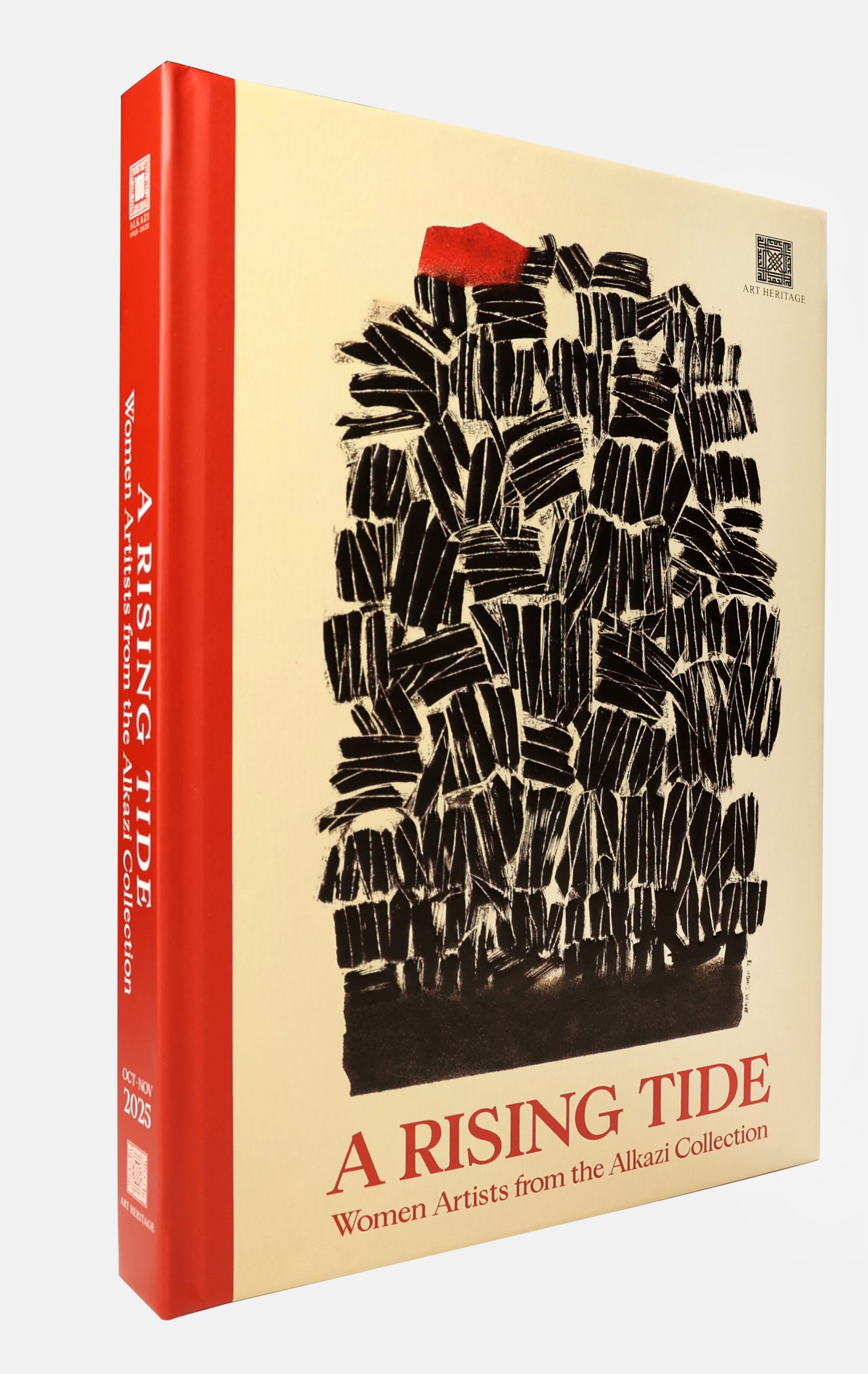
A Rising Tide: Women Artists from the Alkazi Collection, Catalogue, 2025, Book Cover courtesy Nancy Adajania and Art Heritage.
They cover a broad spectrum of women artists whom the Alkazis championed, in their capacity as collectors and gallerists, but also as friends and mentors, from the 1970s to the early years of the 21st century. Adajania allows herself to be guided by the convulsive energy of the artworks collected over this period, the centrifugal histories and individual struggles that comprise them, and refuses to yoke them to a singular theme, or overarching narrative. It is a deeply productive choice, which allows the different formal, artistic, intellectual, social, and political veins folded within the long arc of this collection to emerge.
The exhibition featured artists like Nalini Malani, Arpita Singh, Yayoi Kusama, Arpana Caur, Anupam Sud, Latika Katt, and Gogi Saroj Pal, who emerged as major voices in the 1970s and 80s. Some remember it as a time when small cliques of male artists maintained a stranglehold over cultural institutions and jealously guarded the awards and endowments conferred by them. It was also a period that witnessed the rise of the first feminist movement of post-independence India, galvanized by a series of ghastly gender atrocities, including the Mathura rape case, the Roop Kanwar sati incident, and the Shah Bano verdict, as well as the daily occurrence of violent crimes against women all across the country.
Adajania asks us to consider the way in which the artistic practices of these women converge with the different feminist struggles that were taking place around them. Many felt a degree of ambivalence in identifying themselves and their work as feminist, and only a few, such as Anita Dube or Navjot, embraced the label in all its political and ideological implications. At the same time, as Adajania notes in her curatorial monograph, the women represented in the Alkazi collection lived feminist lives by virtue of their “life choices and artistic predilection”, without translating them into “artistic rhetoric”. Their disavowal of the term “feminist” was only reflective of a certain unwillingness to preach what they practiced, as it were.
The paintings, collected over four decades, also resonate with Alkazi’s dramatic sensibilities, which drew him to stories featuring powerful, unruly, and contrarian women, such as Gandhari in Dharamvir Bharti’s Andha Yug, or Euripedes’ Medea. These characters, as Adajania notes, manifested a kind of “elemental, atavistic” force that Alkazi was keen to tap into in his stage productions. Several of the artworks on display invoke similarly irrepressible, ungovernable, primal forces associated with chthonic goddesses, and the power they held over both life and death. The forceful incarnations of the feminine, both sensuous and defiant, painted by the likes of Nalini Malani and Gogi Saroj Pal, disturb the long tradition of the female nude in western art. In Malani’s Women in a Pink Room, the subject is shown with her head thrown back, hands crossed behind her, in a position of dishevelled comfort and unself-conscious ease.
Even as she refused to impose any singular meaning on the exhibition, in deference to the slow, organic, and necessarily contingent way in which the Alkazis’ collection was built over many decades, Adajania’s curation is fully attuned to its broader, cultural significance. It offers a model for writing a different history of modern Indian art, where the canon reflects the diversity of practitioners, constructs new lineages, and builds a formal, visual, and thematic storehouse for contemporary practitioners to visit and explore.
Woman Is As Woman Does, opened three years before A Rising Tide, as part of the centenary celebrations of the CSMVS museum in Mumbai, and was on display at the Jehangir Nicolson Art Foundation and Premchand Roychand Gallery between August and October 2022, looks at a similarly long arc of female artists, but bears a stronger curatorial imprint in both the selection of the artists and artworks, as well as its avowedly political positioning. It is clearer in its articulation of visual expression with the feminist struggles– or chalval, to use the more evocative Marathi term preferred by Adajania– of the 20th century, in India, which began with the most basic affirmation of rights to life and identity.
The show covered five generations of women artists, from Zarina Hashmi (1937-2024) to Al-Qawi Nanavati (b. 1995), weaving them together across differences of history, region, caste, class, and medium. These differences are in fact crucial in formulating the different subject positions of the artists involved, and emphasizing their commitment to an inclusive, intersectional feminist politics. This is especially true of the younger generation of women artists and activists, whose politics is rooted in solidarity with other forms of marginalisation, including caste, class, ethnicity, language, and the environment.
This diversity extends to the variety of media and formal choices that are represented in the show. Shebha Chachhi’s photographs closely document the Indian women’s movement from the 1980s onwards, with powerful images of mothers of dowry victims, as well as protest marches, and street plays by groups such as Safdar Hashmi’s Jan Natya Manch. Nilima Sheikh’s series, When Champa Grew Up, depicts the life of a young girl across 12 paintings, from a relatively carefree childhood to her marriage, culminating in her tragic death– a dowry-murder at the hands of her in-laws.
For the show Sheikh went back to this 1984 series and the idea of “Revisiting Champa” (2022) was born in conversation with Adajania, where she used her older preparatory drawings to make new interventions.
In ‘Revisiting Champa’, she reconsidered the original series through painted and textual annotations. In one of the drawings, she alludes to a convergence of ‘do waqt’ or two tenses. The past is clearly not yet past. As the artist’s textual insertions show, violence against women has increased dramatically in the present – Nirbhaya, Hathras, Unnao, Kathua.
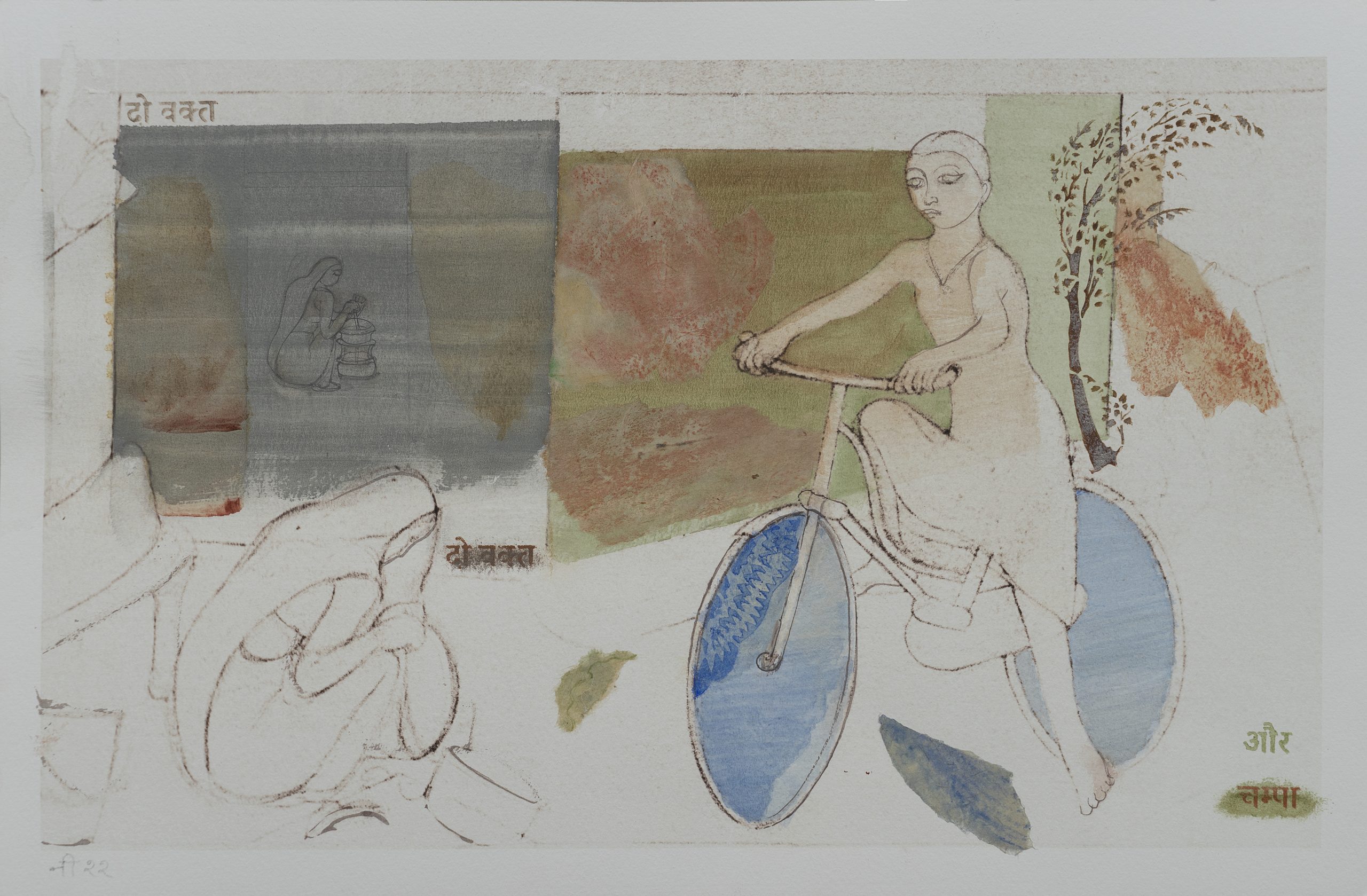
Nilima Sheikh, Revisiting Champa – part 1, 1984 – 2022, 30.48 x 40.64 cm Mixed media on handmade paper, Copyright and courtesy of the artist
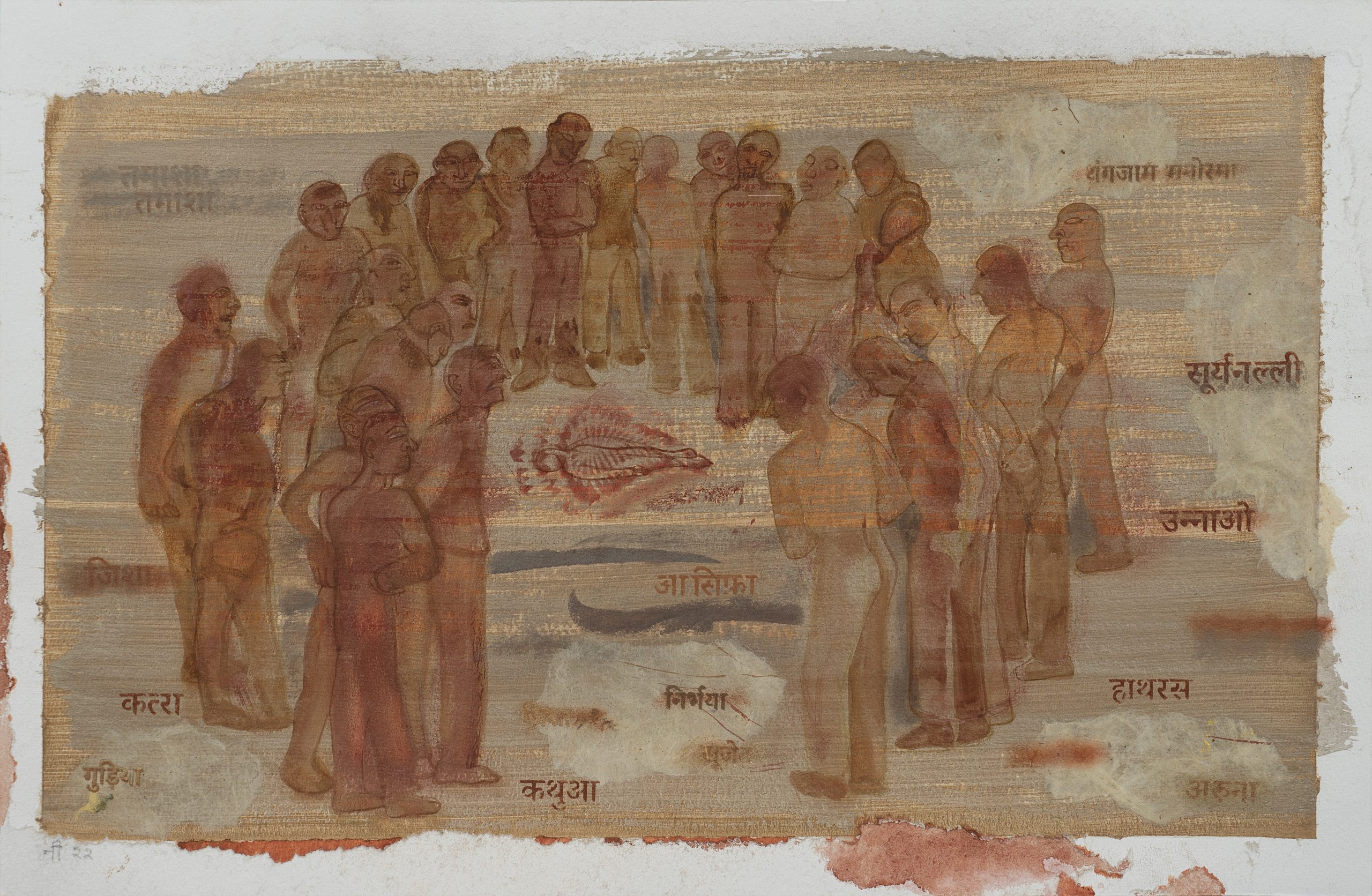
Nilima Sheikh, Revisiting Champa – part 10, 1984 – 2022, 30.48 x 40.64 cm
Mixed media on handmade paper, Copyright and courtesy of the artist.
Alongside ‘Revisiting Champa’, Adajania showed documentation of ‘When Champa Grew Up’ and one of the anti-dowry Gujarati songs, which had accompanied the original series in ‘Woman Is as Woman Does.’ This was an important breakthrough achieved through curatorial research, since until then the existing writing on ‘When Champa Grew Up’ mainly focused on the paintings as art objects with little reference to the accompanying Gujarati activist song texts.”
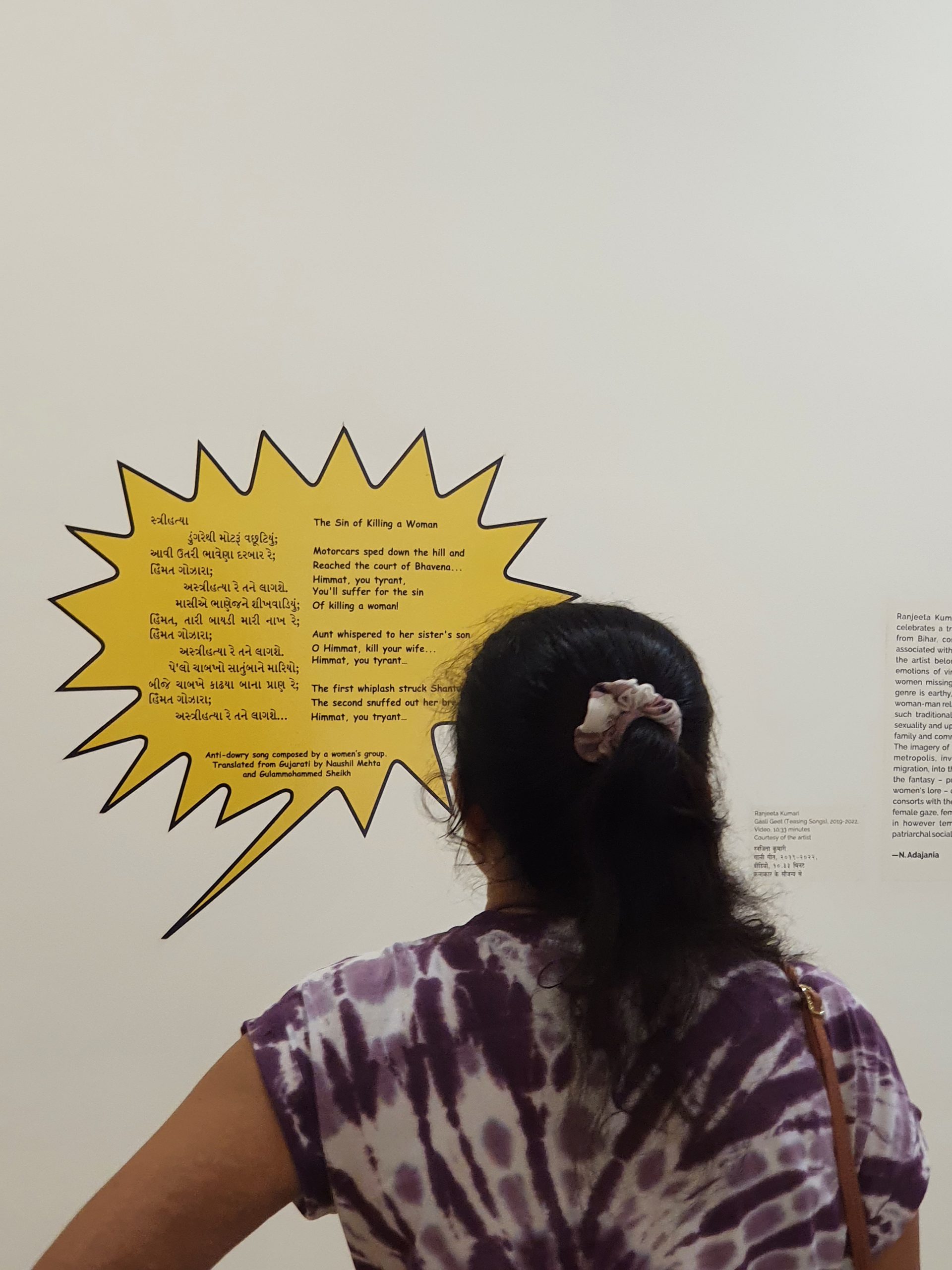
Anti-dowry song composed by a women’s group in Gujarat in the 1980s, displayed as a speech bubble in ‘Woman Is As Woman Does.’ Songs such as these accompanied Nilima Sheikh’s series ‘When Champa Grew Up’. Image courtesy JNAF/CSMVS Museum.
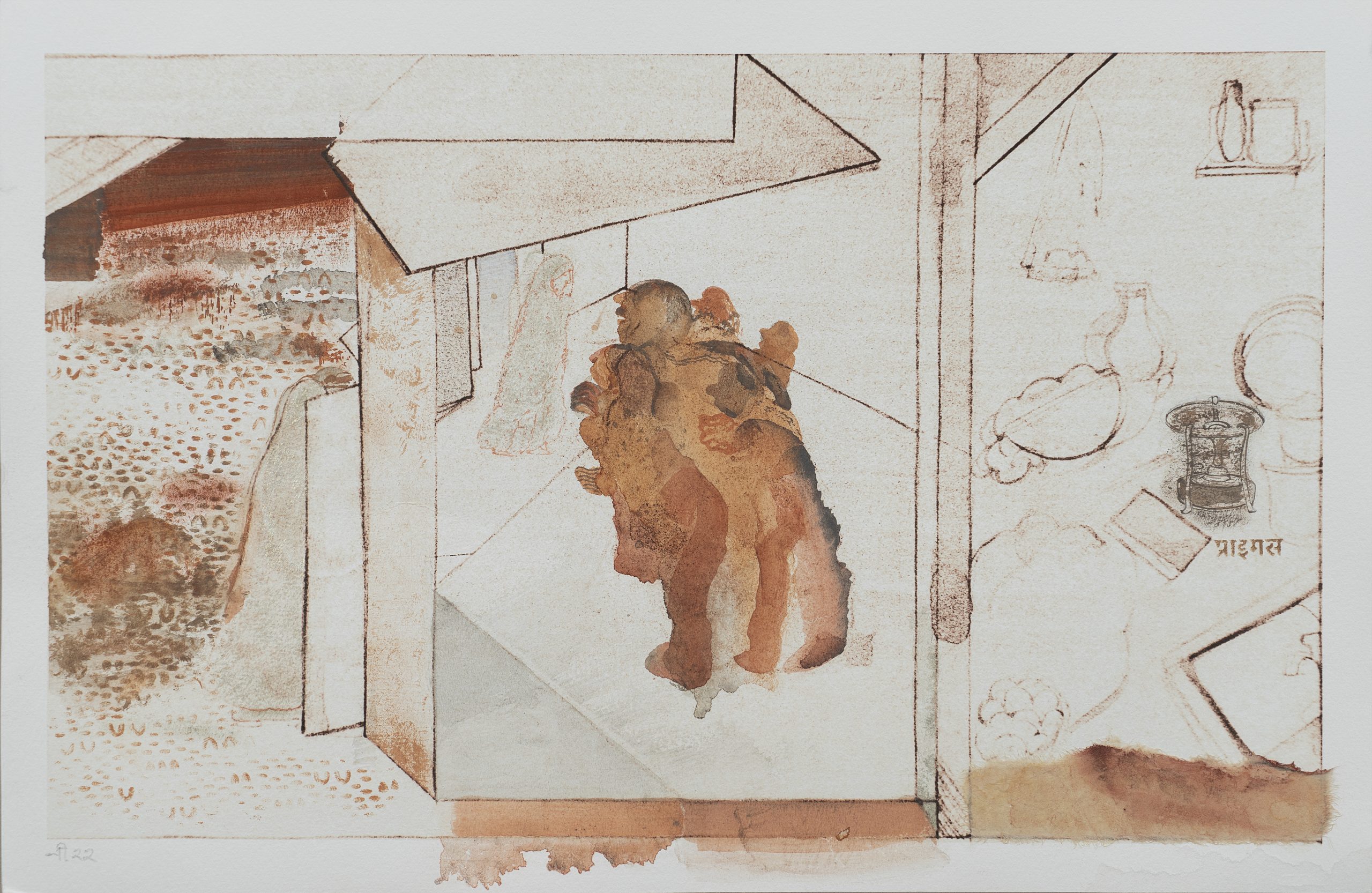
Nilima Sheikh, Revisiting Champa – part 4, 1984 – 2022, 30.48 x 40.64 cm, Mixed media on handmade paper, Copyright and courtesy of the artist
Others, such as Durgabai Vyam, working in the traditional Gond style, have taken up political questions related to the struggle for Dalit rights, especially through her 2011 graphic biography of Dr. Ambedkar, Bhimayana. The show featured not just graphic novels, but also zines, such as those by the Mumbai-based artist Aqui Thami, who belongs to the Thangmi and Kiratima indigenous Kiratamma people of the Himalayas. Paromita Vohra’s delightful 2002 documentary, Unlimited Girls, was also screened on a wall of the gallery, revelling in a kind of mischievous, playful feminism that embodied the quirks and humour of early internet culture. The curation also included non-binary artist Sharmishtha Ray’s participation in the Elle India magazine photo feature #Ungender (2015) – which banished the stereotypes and stigmas associated with conventional gender constructs in a radical act of queer self-fashioning.
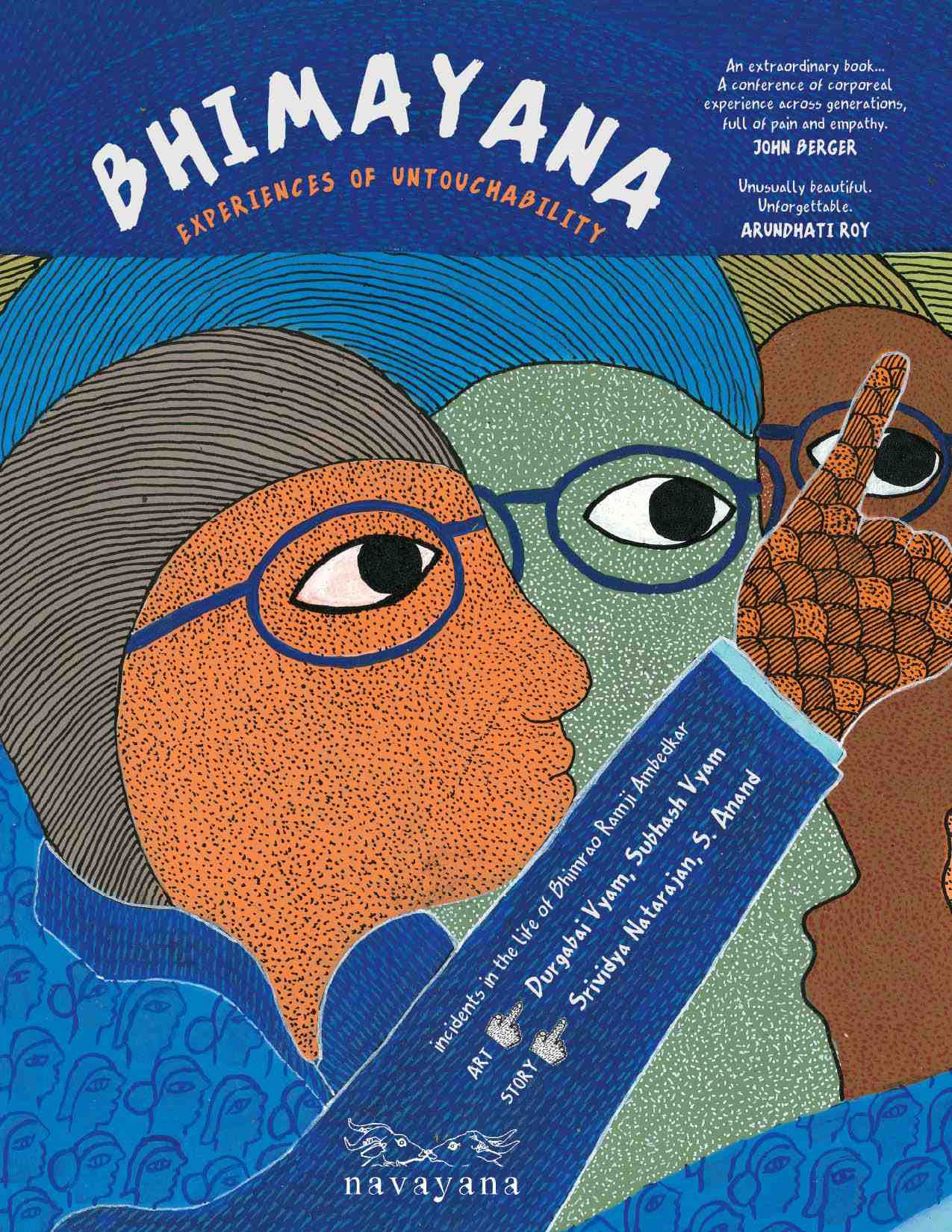
Bhimayana (2011), Durgabai Vyam, Published by Navayana.
The show presents an interesting trajectory of feminism in India through its visual culture. While its early phase was dominated by legal and juridical struggles as well as social protests aimed at stemming the tide of everyday, murderous violence faced by women, it has evolved to include broader struggles for freedom, equality, justice, and ecology. There is also a greater emphasis on individual rights, sexual liberty, and gender self-fashioning. Woman Is As Woman Does exults in the polyphonic, multitudinous character of this movement and the audacious forms of creative expression that it has generated.
While both shows are explorations of gender and femininity, they impose substantially different challenges on the curator. For A Rising Tide, Adajania had to work within the constraints of a major collection built over several decades, while Woman Is As Woman Does represents a more open-ended mandate, requiring endless curiosity and inventiveness. Yet, both shows work by illuminating the way in which women artists in India have responded to the world around them, registering their vivid, visceral reactions to its beauty and violence with great skill and imagination.