
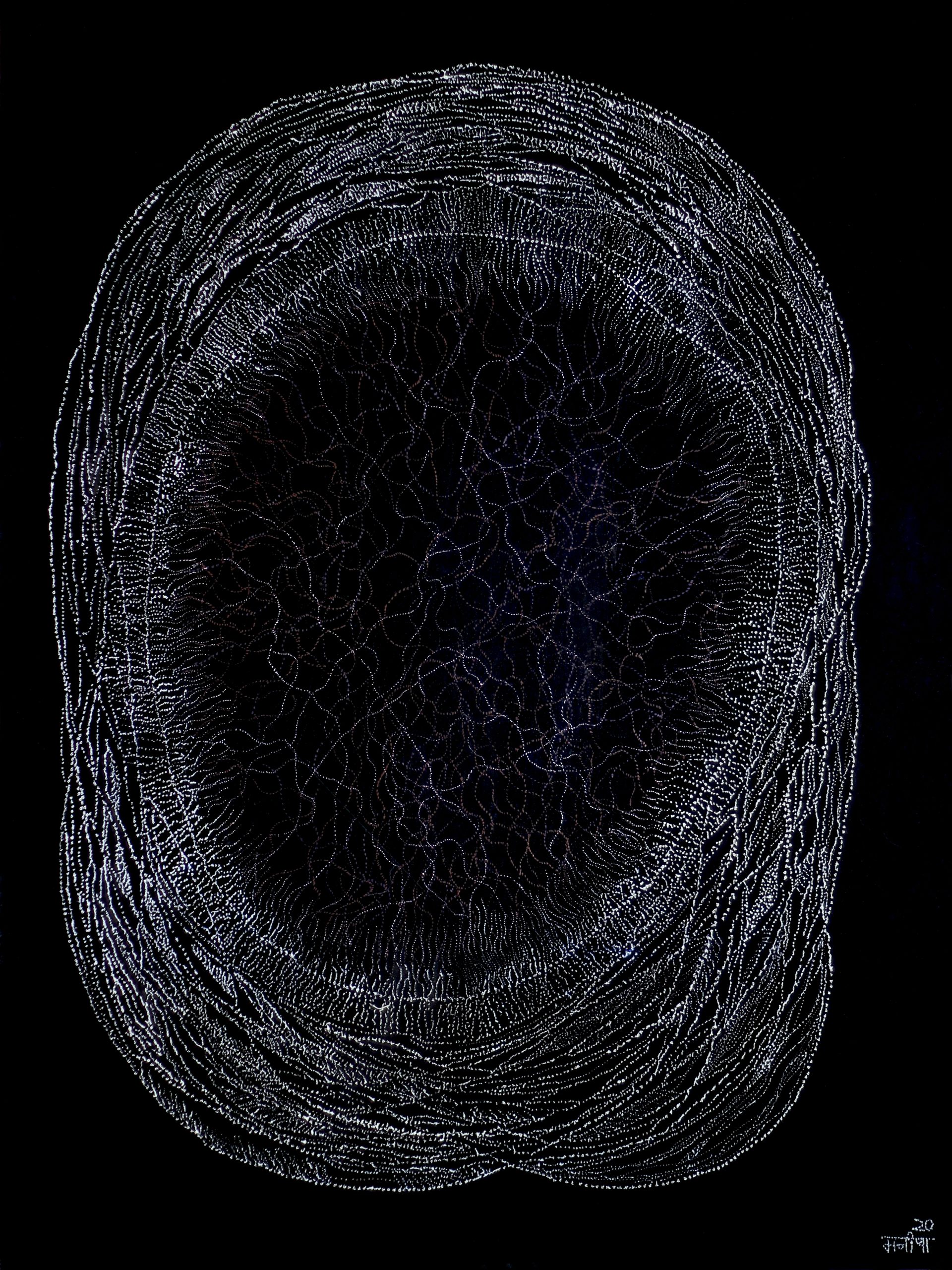
Origin Story
And so, Brahma, the spider,
spins again a silver web. His body
is all night. Stars pin themselves
around his eight ankles across
all eight directions as we spill
from his spinneret like spiderlings
waking into life. And Mother to us all,
he balloons on an orb of thin air,
leaving a field of silk below—
wound three times, no, thirty-nine,
so much sturdier than steel—
circling the oval mouth of starlight.
And we, his gossamer children,
huddle around his hairy legs
like so many sticky pests,
like chalk dust on a blackboard,
and warble: tell us once more,
how you began time.
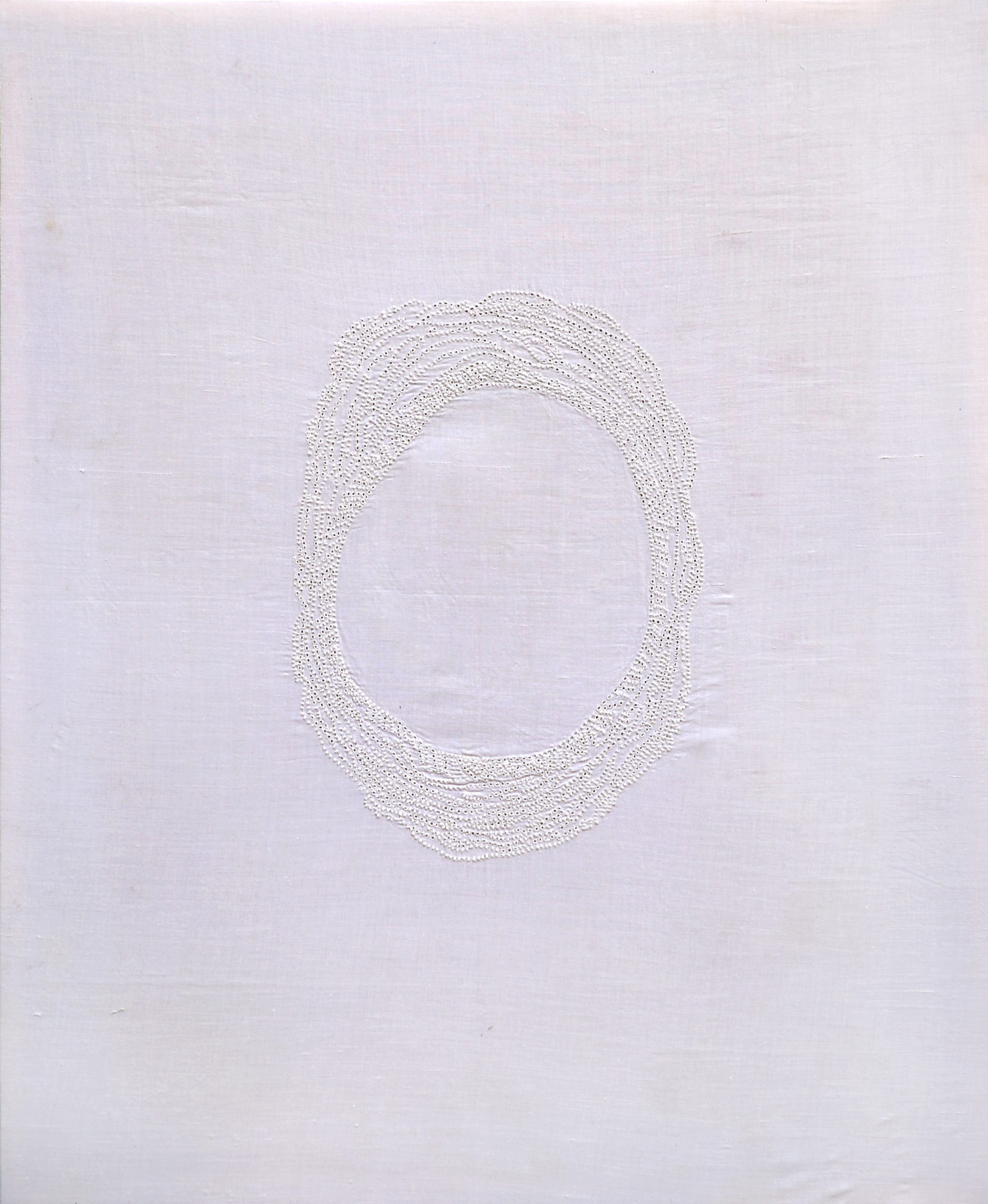
Manisha Gera Baswani, Safed Talaab, 2025, Chikankari on cloth,
21.5 x 17.5 inches, Courtesy Manisha Gera Baswani & Gallery Espace
The White Poem
Like a new lamb, I wake into the morning—
I look outside and see a thin crust of snow
stitched upon another layer of snow. The green
of lank grass below barely peeking through.
It is almost December in Oslo, too, where my friend lives.
He speaks of the sun reflecting on the bright white sheet—
the pond frozen over—beneath which fish swim, enter
a sleep where their hearts slow—a torpor—while the sun
goes on sharpening his winter glare. My friend can bear
this shine, says it is better than the aphotic dark of November.
Here, in Narkanda, I spot the monal somewhere on a slope.
We look at each other but do not speak. In the distance,
children ready themselves to ski, awkward ducks
falling over. In the cold air is a light I cannot name—
it feels old—numinous—blunts whatever is glottal
inside me. It doesn’t hurt, being alone. Going for days
without hearing the whistle of a partridge or the heft of hail
thunking its weight on the tip of a deodar leaf. The snow
is so cold, it feels hot. I do not know what that means.
But in the presence of a presence greater than your own,
something tells you, you should kneel. And so, I kneel,
bald knee to the ground, and cry softly into the snow.
My sobbing is so quiet I cannot hear it. I think of my friend
walking in the open, drinking warm beer to soothe his throat.
Tomorrow, he will shovel snow. And in a month or two,
the winter glare will reduce. Fish will wake from their sleep
and the pond will thaw too—thinking of this, I rise
on my feet, here, in Narkanda. Thank whatever presence
has blessed my mouth with a silence so deep, I contain
no language to hold it—like this poem turning
into a heap of snow. I have no use for words now.
There is nothing to show.
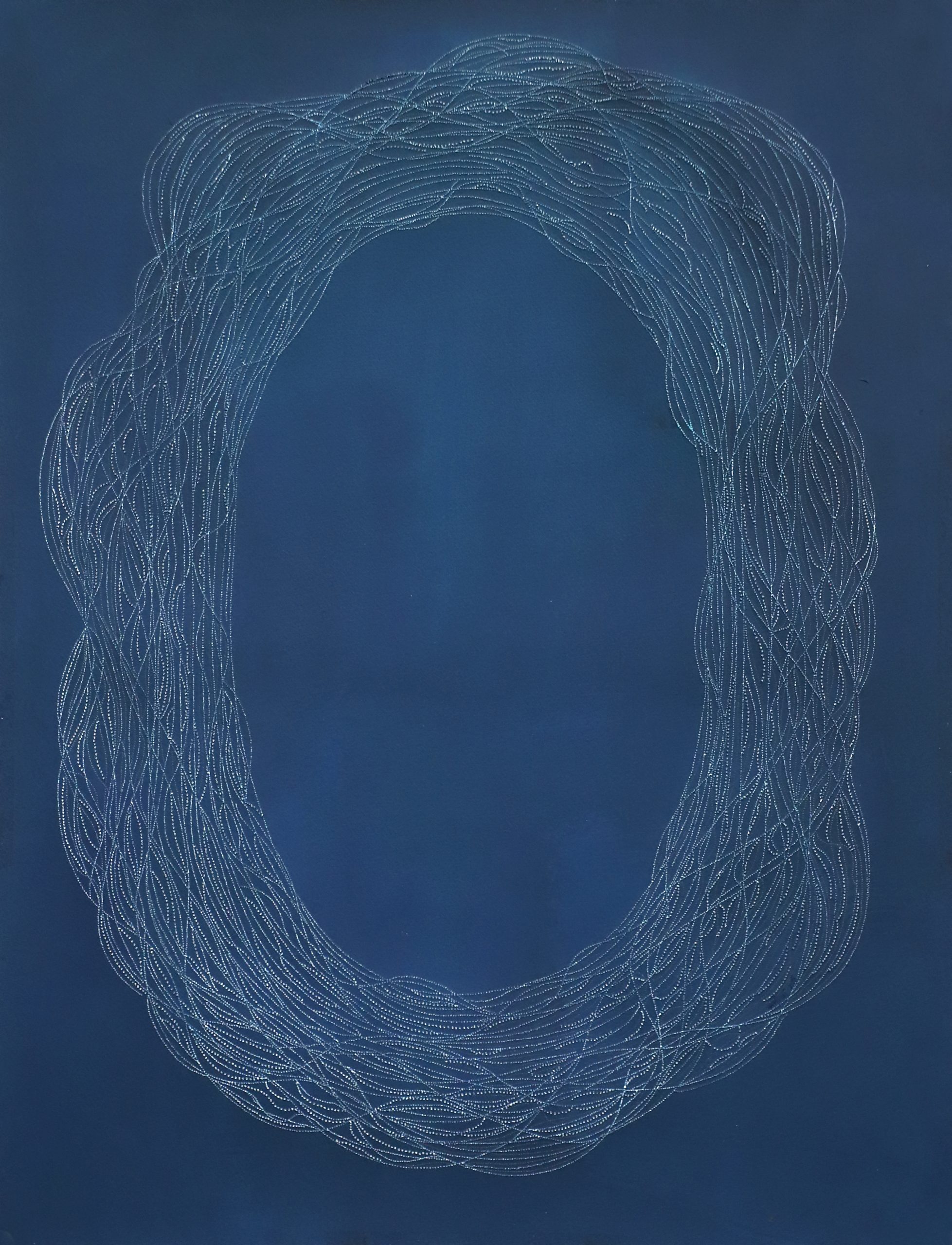
Manisha Gera Baswani, Talaab, 2024, Pin Incision & gouache on Paper
24 x 18 inches, Courtesy Manisha Gera Baswani & Gallery Espace
On blue
In the woods, I walk to the pond with my book,
and hold fast to the idea that deer can see the colour blue,
that the cones of their eyes allow such light
to enter, pass through—and the idea of it soothes
my mind, and I imagine one such fawn fevered with thirst,
drinking from the lip of a pond, the water good to taste,
like a lozenge cooling the canal of your throat—
and what is it in the way of blue, the way it reaches the eye—
the long stem of a needle my mother sterilizes on a blue flame,
the tarpaulin of sky, pots glazed with a blue pigment,
feathers of a jay,
pieces of broken azure tiles that children play stapoo with—
is it all in the eye?—in the sea cave of Blue Grotto
where an emperor once swam, the light there so sapphire
it seems to filter from the stained window of some hidden cathedral,
or emit upwards from a star burning underwater,
the silver blued and the blue, silvered—I look,
and look, I am changed—I am Yashodha
coaxing open Krishna’s blue mouth to reveal
a bazillion stars burning bright
in the eternal darkness of space, there is
such light as you wouldn’t believe, couldn’t conceive,
the smooth marble of earth so small in this boy’s maw
that I, his mother, am left frightened—but not I, who is staring
into the clear iris of this pond, divining with my eye
a blue that cannot be found, a blue so vivid
I cannot foresee what I ask for, what I want
from these slow waters where the fish pivot & pray,
I want something impossible
like a formless shape, a knife without a blade,
or to touch the bony ridges on a mandrill’s face—
I want not to hew or whittle or snap or break—
I only want to behold a blue so large & undivided
that it returns the sky to the sky—
but as I stand here staring at the center of the pond,
wanting not to want the impossible, I know
that the blue I see is not the blue a deer sees,
for she sees a colour twenty times bluer,
a blue so bluishly deep, I wouldn’t know what I would do—
and in the light of this truth, I confess
that I suffer a little like a leaf in the wind
but nothing so grave as to kill a horse—one blue roan, or two—
and I still don’t know what it is in the way of blue
except it is the colour of dreams, threading everything I see—
iguana, brick, candle, hook—and I return to it like I
return to the pond, a mud dauber to her nest,
a rook to his tree, and how to my eye, the light returns,
repeats, not the deer’s blue but my own still,
through the gift of a pupil—vase and coat
and ladder and sieve—all as blue as blue can be.